Owls
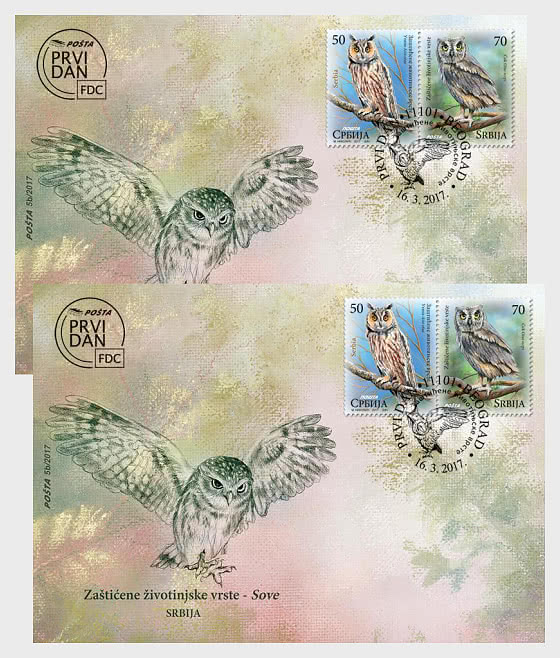
Пошта Србије пустила је у оптицај 16. марта издање пригодних поштанских марака под називом „Заштићене животињске врсте”. На четири марке овогодишњег издања које је уметнички обрадио Мирослав Николић, креатор марака Поште Србије су сове које настањују наше крајеве, кукумавка, куквија, утина и ћук. Марке носе ознаке номиналних вредности 23, 46, 50 и 70 динара, а штампане су техником вишебојног офсета у табацима од по 20 комада са вињетом у средини табака. Тираж издања, које је штампано у ЗИН у Београду је 65.000, а прате га и два FDC коверта. Жиг првога дана носи датум 16. март 2017, поштански број 11101 и назив издања „Заштићене животињске врсте”. Стручна сарадња у реализацији овог издања пружио је Милан Ружић, председник Друштва за заштиту и проучавање птица Србије – BirdLife Serbia.
Little owl (Athene noctua)
The Little owl is a small owl that prefers to live near people. It chooses open and mosaic habitats with scattered trees, pastures, rockeries, abandoned buildings, orchards, parks, farms, human settlements. It hunts large insects and small mammals, rarely amphibians and earthworms. Little owl does not build a nest but uses natural cavities in trees, walls, loess profiles, cliffs and attics. It accepts specially designed nesting boxes. It nests from April to June. In Serbia there are 14,300 to 21,000 nesting pairs, and the population is stable.
Barn owl (Tyto alba)
The Barn owl is a medium size owl with a prominent heart shaped face. It nests mainly in the lowlands of Serbia. Estimated population in Serbia is 3,400-5,100 pairs and slightly decreasing. The Barn owl chooses open habitats with plenty of grasslands where rich food sources are found. Often, it resides in human settlements. The main prey of this owl are voles, mice, rats and shrews. It nests in attics, holes in the walls, hollows of trees, or stacks of straw. It accepts specially designed nesting boxes. Barn owls nest usually once a year, but when food is plentiful there can be two clutches.
Long-eared owl (Asio otus)
The Long-eared owl is a medium sized owl that lives throughout Serbia, from lowlands to high mountains. It feeds mainly on small rodents such as voles and mice. They do not build nests, but use or take over old nests of magpies, crows and other birds. It nests from mid-March until the end of June. The estimated population in Serbia is 19,000 to 28,000 pairs and moderately increasing. During winter, Long-eared owls gather in large roosts that can count hundreds of individuals, mostly staying in human settlements.
Scops owl (Otus scops)
The Scops owl is the only true migratory bird among the owls that live in Serbia. It inhabits the whole of Serbia, from the lowlands to the hilly and mountainous areas. Habitats are open and semi-open with single trees or small groves, parks, gardens, rockeries. The main prey of the Scops owl are large insects, such as grasshoppers, crickets, beetles, and moths. It mostly chooses tree cavities for the nest, rarely man-made objects or nests of other birds. It gladly accepts bird-boxes. Nesting is from April to June. The estimated population in Serbia is 27,500 to 43,500 pairs and stable.