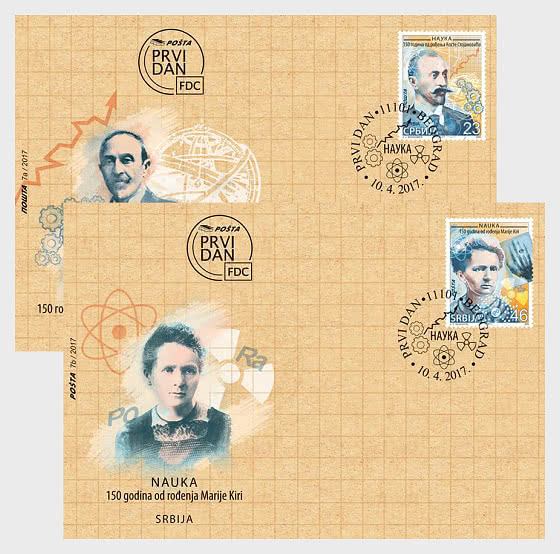
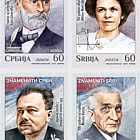
Kosta Stojanović (Aleksinac, 1867 – Belgrade, 1921), professor of applied mathematics at the University of Belgrade, the author of papers in the field of mechanics, physics, economics and sociology; an enlightened statesman, eight times minister in the governments of the Kingdom of Serbia and the Kingdom of Serbs, Croats and Slovenes, a negotiator at the Paris Peace Conference in 1919, a signatory to the treaty of Rapallo in 1920. His scientific method was grounded in the works of Ruđer Bošković, and he was among the first to write about him in 1891. He was the first to introduce mathematics in economic sciences, in his piece On import and export in Serbia – matter treated by a new mathematical method, published in 1902, where he calculated that Serbia loses eight dinars on each dinar of export, and developed scientific management of the national economy, which led to the victory of Serbia against Austria-Hungary in the Customs War. Afterwards, in his piece Basic Principles of the Theory of Economic Values, published in 1910, he was again the first to introduce higher mathematics in economic sciences. In his discussion paper Theory of Physical and Social Phenomena, published in 1910, he developed a general theory of society, based on thermodynamics, and established a system of categories that allow copying of the natural processes to social phenomena. His life work was completed with an unfinished attempt to give the form of mathematical laws to the First World War. He was the forerunner of cybernetics that allowed for very accurate predictions of important historical flows relevant today. He fought against the ideology of communism as a form of cosmopolitan social entropy, which undermines the moral foundations of the state. He died unexpectedly, only few days after taking over the position of the Minister of Finance, at the time when he was completing the Law on the Revision of Property of War Profiteers.