2017Flora - First Day Cover
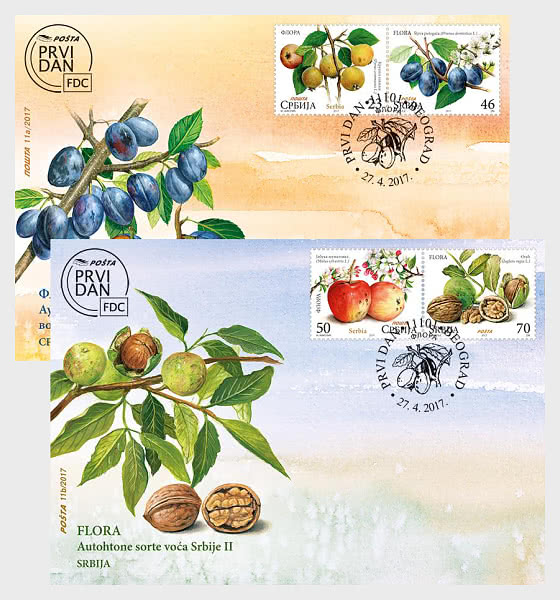
- 27.04.2017
Old heirloom variety of our region, of unknown origin, today almost extinct. There are two types of this sort: white and black. The white one is bigger and more widespread.
It ripens in September and the fruits can be eaten only after bletting. The fruits are small, about 25-30 in a kilogramme, with thick and coarse yellowish-brown skin. The flesh is of honey colour, crunchy, sweet, not too juicy, refreshing in taste and with fragrant aroma. This cultivar can be eaten raw or processed – it makes jam of excellent quality, but can be dried as whole fruit as well. It is disease-resistant and can be grown without protection. The tree is luxuriant, healty and long-living, with large cauldron-shape crown. The trees are high-yield and produce up to 1,000 kg of fruit per season. This cultivar is prone to biennial bearing.
Plum Požega (Prunus domestica L.)Naturalised cultivar that originates in Asia Minor. Požegača is grown throughout Europe, but Serbia acquired high reputation in growing this variety because of the high quality of fruit grown in our geographic area.
It matures in the first half of September but can be harvested throughout that month. The tree is luxuriant and strong, with dense pyramidal crown and high fruit yield. A fruit is small to medium-sized, of irregular oval shape, dark blue, and has a dusty-white waxy coating and a shallow groove running down one side. The flesh is gold-yellow, firm, juicy, aromatic, recognizable by its sweet-sour taste, of excellent quality. It can be separated easily from the pit. The fruit can remain on the tree for a long time and survives transport very well. This variety is very susceptible to plum pox virus and highly endangered in our region. Požegača has an ideal ratio of sugars and acids, making it the highest-quality plum in the world, and perfect for making top-quality slivovitz brandy.
Apple Šumatovka (Malus sylvestris L.)The old, autochthonous variety of our region, widespread in many regions in Serbia, especially around Vranje, in Toplica and Central Morava regions and in Kosovo. This is a real winter sort, of late ripening: it matures at the end of October and its fruits remain in fine shape until the new harvest. The tree is very luxuriant and has a narrow pyramidal crown.
The fruit is small (50-80 g), of elongated-globous shape, has a greenish-yellow basic colour of the skin, covered by the dark-red supplementary colour on the sunny side. The skin becomes oily during storage, which is beneficial to the longevity of the fruit. The flesh is whitish, firm, sweet-acid, juicy and melts on the tongue and has a characteristic flavour. It is resistant against the apple scab. The apple Šumatovka grows well in all terrains, both in lowlands and in mountain areas, and the tree is vital and resistant to pests and diseases. In full ripeness, trees may yield up to 1,000 kg of top-quality fruits per season. The tree is resistant to severe frost, but also to summer droughts and strong wind, as the fruits do not fall off. This variety of apple may grow in conditions when other cultivars cannot survive. It is suitable for growing without chemical protection and for long storage, and the fruits acquire a finer fragrance in time.
Walnut (Juglans regia L.)Walnut is a fruit from the Northern hemisphere. It is believed that it originated in Persia. In time, it spread over Europe, Northern and Central America and Australia.
A long-lived fruit tree, reaching a height of up to 15m and having a large and beautiful tree with a branched crown, it can live for several hundred years. Walnut forests were once present in our country, and today it is found in communities with oak, chestnut and hornbeam forests. Walnut grows singly or in groups, spontaneously grown or planted. Despite the excellent ecological conditions for plantation cultivation, walnut is not widely distributed in our country.
In some parts of our country certain characteristic biotypes are separated, such as moravski orah, widespread in Pomoravlje area (around the Morava river).Almost all parts of walnut (nut, shell, leaf, bark and wood) are widely used and valued in nutrition, medicine, food industry, pharmacy, cosmetics and timber industry. The nut is of great importance for nutrition, because of the high concentration of oil, proteins, minerals, iodine and vitamins. The walnut proteins can replace the proteins of animal origin. Catkins, buds and young fruits are used in preparation of various medications and preparations.
Serbia - Recommended stamp issues









WOPA+ recommended stamp issues

| Avatar - Fire and Ash |
| Issued: 03.12.2025 |
| ›New Zealand |

| 50th Anniversary of the Founding of the 24th November Bar Scout |
| Issued: 24.11.2025 |
| ›Montenegro |

| Krisjanis Valdemars |
| Issued: 02.12.2025 |
| ›Latvia |


| Sign Language - Good |
| Issued: 02.12.2025 |
| ›Bosnia and Herzegovina - Republic of Srpska |

| In Memory of the Fallen and Murdered on October 7, 2023 |
| Issued: 08.10.2025 |
| ›Israel |


| Annual Collection Folder (New York) |
| Issued: 05.12.2025 |
| ›United Nations |

| Year Set |
| Issued: 24.11.2025 |
| ›Isle of Man |

| Shipping in the 17th and 18th Centuries - Peat Shipping |
| Issued: 05.12.2025 |
| ›Netherlands |