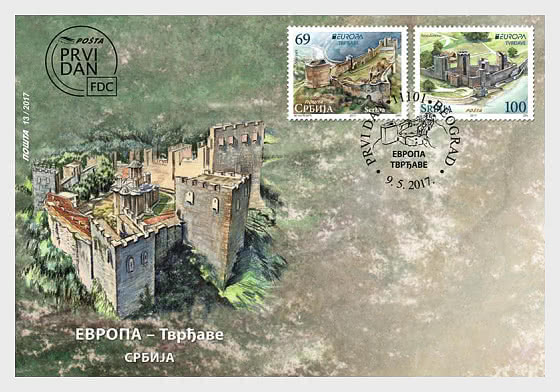
In medieval Serbia, as well as in other parts of Europe, fortresses and fortified towns were built in prominent places. As a result of the Turkish invasion in the Balkans in the second half of XIV and the beginning of the XV century, the monasteries were fortified as well, such as the Manasija Monastery (Resava). The monastery, constructed in the Morava style, is surrounded by imposing walls and eleven pinnacles. It was built by Despot Stefan Lazarević, between 1406 and 1418.
The Maglič Castle was built in the Ibar river valley, on the narrow ridge dominating the entire surroundings. The castle was probably built in the first half of the XIII century, after the Mongolian invasion into Europe. The records of it date from the time of Archbishop Danilo II, between 1324 and 1337, who reconstructed the walls, the church, the palace and other buildings. The castle lost its importance after it fell to the Turks. Maglič resumed its strategic importance at the time of the Great Vienna War (1683-1699) and the Second Serbian Uprising. The castle is surrounded by the river from three sides, while on the eastern side a moat was dug in the stone.
The Maglič Castle is built in the form of elongated rectangle, with a keep and seven massive towers ten metres tall. The interior of the castle hold the remains of the palace of the lord of the castle, archbishop’s palace and a single-nave Church of St. George. The Maglič Castle as a cultural monument was registered in the list of the immovable cultural heritage of remarkable importance in 1982.
The Smederevo Castle is one of the most impressive medieval lowland forts in Europe. It was built by Despot Đurađ Branković, near the Danube and Jezava rivers and the Petijevski stream, has a triangular base divided into the Small and the Large Towns. The Small Town was the fortified ruler’s palace surrounded by a moat and has six towers. One of them bears the inscription that the city was built in 1430. The walls on the land-facing, easily accessible side, were fortified with 19 towers, each eleven meters wide and twenty meters tall. As the cannons emerged as a new weapon, the most massive walls were erected on the southern side, in some places 4.5 metres thick. Smederevo fell to the Turks already in 1439. With his skilful diplomacy, Despot Đurađ managed to recover the city in 1444 and complete the construction by 1453. However, already in summer 1459, Smederevo fell in the hands of Sultan Mehmed the Conqueror. In 1480, the Turks added one polygonal tower in each of the three corners. The fortress and half of the town were badly damaged by the explosion of ammunition in 1941. The Smederevo Castle was registered in the list of the immovable heritage of remarkable importance in 1983.