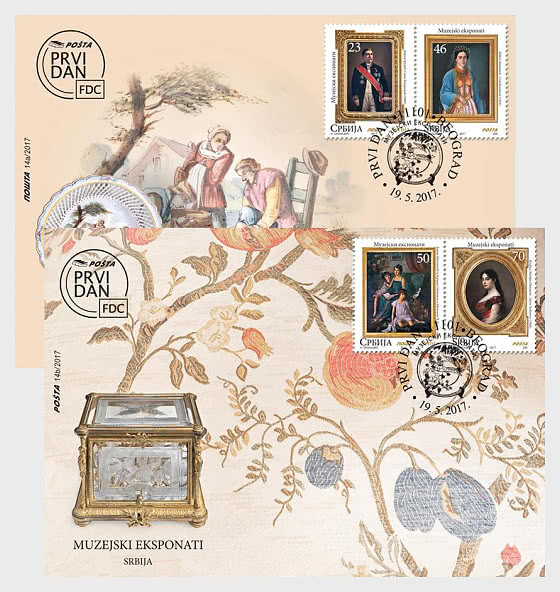
2017Мuseum Exhibits - First Day Cover
When you enter the Jevrem Grujić’s House, you take a step into the past, the Serbian tradition and avant-garde. The Serbian statesman and diplomat Jevrem Grujić (Darosava, 1826 – Belgrade, 1895), built the house for his family at the end of XIX century (in 1896) following the design made by the prominent architect Milan Kapetanović. The house was designed as a one-storey urban villa inspired by French Neo-Baroque and Neo-Renaissance. The facąde decoration is the artwork of Domenico D’Andrea, an Italian master of decorative art, and imitates sgraffitо style, very rare and almost a unique example in the architecture of Belgrade. During XIX and XX century, the Belgrade balls were organised in the state room of the house, which was also used as a gathering place for the Serbian social elite and diplomatic meetings where the political and intellectual champions of the time made decisions on the future of the young Serbian state. This is where the secret treaty between Serbia and Bulgaria for liberation of the Southern Slavs was signed in 1912, later used as a base for formation of the Balkan League. The Queen Maria Karageorgevitch visited the Grujić family unannounced and without protocol. Fifty years later, in 1967, the very first Belgrade discotheque was opened in the basement of the house, marking the start of the sociological boom in the modern history of the City. The House of Jevrem Grujić is the first cultural monument protected by the Institute of Protection of Cultural Heritage of the City of Belgrade after its foundation in 1961, and in 1979 the building was declared the cultural heritage of great significance for the Republic of Serbia. In September 2015, thanks to the generosity of heirs of Jevrem Grujić, a section of the house was made into museum, in which a part of the rich collection of Jevrem Grujić’s House is now displayed. All the exhibits, along with the archive documents, photographs and literature assert the importance of the families which have been connected and joined by this House for more than two centuries, as a symbol of familial continuity and tradition of the Serbian heritage. Now the Museum House, it is a meeting place of history and avant-garde.
Motifs: Jevrem Grujić, Steva Todorović, oil on canvas, 1888, Belgrade (stamp 1);
Mileva Naumović, Uroš Knežević, oil on canvas, 1854, Belgrade (stamp 2);
Jelena Milojević with Daughters Milica and Milena, V. Volkov, oil on canvas, 1925, Belgrade (stamp 3);
Queen Natalia Obrenovitch, Steva Todorović, oil on canvas, 1884, Belgrade (stamp 4);
French plate with perforated edge, porcelain, 1775, Lille (envelope 1);
Liqueur Chest, gilded bronze and crystal, Maison Alphonse Giroux, 1878, Paris (envelope 2 and vignette);
Chinese Glass Case, Louis XV, second half of the eighteenth century, Paris (vignette);
The Cranes, cloisonné, second half of the eighteenth century, China (vignette).
Serbia - Recommended stamp issues



WOPA+ recommended stamp issues

| Avatar - Fire and Ash |
| Issued: 03.12.2025 |
| ›New Zealand |

| 50th Anniversary of the Founding of the 24th November Bar Scout |
| Issued: 24.11.2025 |
| ›Montenegro |
| Krisjanis Valdemars |
| Issued: 02.12.2025 |
| ›Latvia |

| Sign Language - Good |
| Issued: 02.12.2025 |
| ›Bosnia and Herzegovina - Republic of Srpska |

| In Memory of the Fallen and Murdered on October 7, 2023 |
| Issued: 08.10.2025 |
| ›Israel |


| Annual Collection Folder (New York) |
| Issued: 05.12.2025 |
| ›United Nations |
| Year Set |
| Issued: 24.11.2025 |
| ›Isle of Man |
| Shipping in the 17th and 18th Centuries - Peat Shipping |
| Issued: 05.12.2025 |
| ›Netherlands |