2017Art - First Day Cover
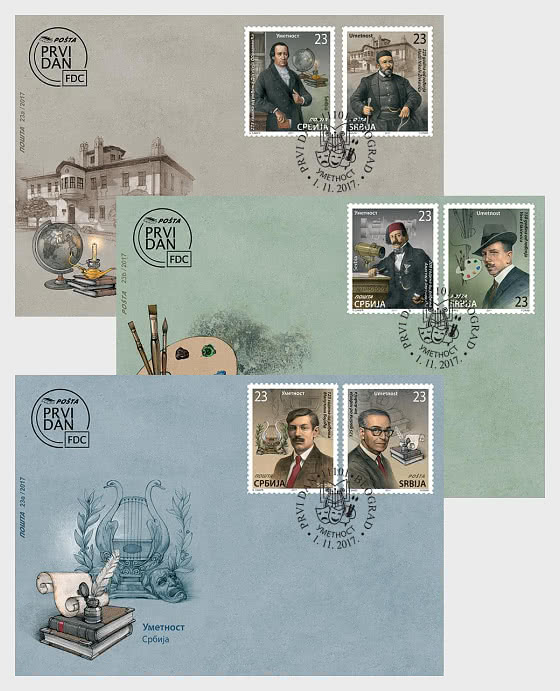
- 01.11.2017
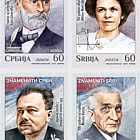
Dositej Obradović was born in 1742 in Čakovo (Romanian part of Banat) as Dimitrije. He took the monastic vows in 1758 in the monastery Hopovo, and received the name Dositej. After leaving the monastery, he went to Dalmatia, where he worked for three years as a teacher, and went on to Europe and the world, where he got acquainted with the reformist ideas of the 18th century, gained knowledge in philosophy and literature and became interested in Central European enlightenment and cultural and educational reforms. The philosophical background of his programme was the Enlightenment rationalism, adapted to the practical needs of his people. In Leipzig, he printed his programmatic essays: Letter to Haralampios (1783), Advices in Common Sense (1784) and My Life and Adventures (1793), in Moscow – Fables, in Venice Ethics and in Vienna Anthology of Various Things Moral. Having heard the news on the First Serbian Uprisal, he got in touch with Karađorđe and spent the last five years of his life in Serbia, assisting the renewal of the Serbian statehood with his knowledge, and taking active participation in international and legislative affairs. He established the Higher School – future University in 1808 in Belgrade, and the Seminary in 1810. As a member of the Governing Council, he was the first Serbian minister of education, brought Serbia closer to Europe and the world and turned it towards new cultural and civilizational trends. Dositej Obradović died on 28 March 1811 in Belgrade and is buried in the yard of the Belgrade’s Cathedral Church of St Archangel Michael.
Expert collaboration: Museum of Vuk and Dositej, Belgrade.
225 Years Since the Birth of Haji Nikola ŽivkovićHaji Nikola Živković – Haji Neimar (Vodena (Edessa), Greece 1792 – Belgrade, 1870). It remains unknown when he came to Serbia and began his service with the Prince Miloš, but it is known that he was the manager of all the Prince’s constructions. According to legend, he was so conscientious that he knocked each brick to check its quality. Even though we do not know what was his part in the construction of structures, it is thought that he was the head designer of two konaks in Belgrade: The Residence of Princess Ljubica and The Residence of Princ Miloš in Topčider, two representative buildings of the transitory type from Oriental to Occidental (West European) architecture. During the second rule of Prince Miloš (1858–1860), he was the Supervisor of Official Establishments at the Head Administration of Construction in Belgrade. He remained in post in the newly-formed Ministry of Construction until his retirement. His role in the renewed Serbia was so important that he is rightly considered to be the first Serbia’s architect.
Expert collaboration: Belgrade City Museum.
Artistic realization of the stamps: MA Boban Savić, academic painter.
200 Years Since the Birth of Anastas JovanovićAnastas Jovanović (1817–1899), the first Serbian lithographer and one of the first Serbian photographers. Educated in visual arts, a versatile artist, he left behind the pieces of art with exceptional value, diversity and volume.
He was born in Vratza (now in Western Bulgaria). He came in Belgrade in 1826 to became a tailor apprentice. When the National Printing House was opened in 1832, Anastas went there to learn type founding. He cut the Cyrillic letters for the first Serbian alphabet book, printed in 1838 at the order of Prince Miloš. Pleased with his work, Miloš sent him to Vienna, to study copper engraving at the St. Anna Academy. In Vienna, Anastas also studied lithography at Johan Staedler’s studio, and met with a new medium – photography. He mastered the daguerreotype, the technique of making images on a sheet of silver–platted copper, and the photographic technique of talbotype, named by Fox Talbot. In Vienna, he bought a Voigtländer camera with Joseph Petzval’s objective – Model 3, and used it to make talbotype portraits of prominent people. In Vienna, he was the first artist ever to make stereoscopic images. He made more than 200 lithographic images and over 800 photographs of people and events from the Serbian history, and made designs for the first Serbian post stamps. He was the Majordomo of the Court of Prince Mihailo Obrenović.
He died in 1899 in Belgrade.
Expert collaboration: Belgrade City Museum.
150 Years Since the Birth of Vasa EškićevićVasa Eškićević (1867–1933), a Serbian painter and drawing teacher, was born in Irig on January 13, 1867. He first studied barber craft, but then in 1887 he went to Vienna to attend a private painting school. In the autumn of 1893, he enrolled at the State Art School in Saint Petersburg, as a scholar of the Russian state. He also attended a private institute of the duchess Tenisheva in Saint Petersburg, in the class of a famous Russian realist, Ilya Repin, and in 1900 he was admitted to the Imperial Academy of Arts, where he graduated in 1908. He remained in Russia as a drawing teacher until World War I. When the war started, he registered himself as a volunteer and became a war painter of the First Serbian Army. He spent five years in the army and experienced the calvary of Albania, rest and refit on Corfu, and breaking of the Salonica front. He participated in the liberation of Novi Sad, where he lived until his death on January 13, 1933.
He painted in the style of academic realism with the elements of expressionism. Besides painting, he dealt with literary work and translation. He was a member of the Department of Literature of Matica Srpska. The most valuable part of his artistic heritage today is in the Gallery of the Serbian Reading Room and Library in Irig.
Expert collaboration: The Gallery of Matica srpska, Novi Sad.
Artistic realization of the stamps: Boban Savić, М.А, academic painter.
125 Years Since the Birth of Milutin BojićMilutin Bojić (1892–1917) was a poet, playwright, literary and theater critic. He was born in Belgrade on May 19, 1892, where he attended high school and then university. In his youth, he started publishing for Wreath (Venac), Nova Iskra, Artwork (Delo), Serbian Literary Gazette, Daily News and Piedmont. He partook in the Balkan wars, as well as the First World War. Before the war in 1914, he published his first book Poems, about which Jovan Skerlić wrote his last review. He wrote two plays: The King’s Autumn and The Marriage of Uroš, as well as a large number of literary and theater displays. He is the author of unforgettable verses about a tragic part of the Serbian history, about pain and suffering of the Serbian people. In Thessaloniki, he published a collection of poems Songs of Pride and Suffering, featuring 34 songs written in Corfu and Thessaloniki. As a witness of massive dying on the island of Vid, he wrote his most memorable song Ode to a Blue Sea Tomb, which represents a peak of Bojić’s patriotic and romantic inspiration.
He died in a hospital in Thessaloniki on November 8, 1917. He was buried at a military cemetery in Zeitenlik. His mortal remains were transferred to Belgrade around the end of 1922. Although he lived to be only 25, he left an indelible mark in Serbian literature. Expert collaboration: Matica Srpska Library, Novi Sad.
125 Years Since the Birth of Ivo AndrićIvo Andrić (1892–1975) was born in Travnik on October 10, 1892. He finished elementary school in Višegrad, gymnasium in Sarajevo, and studied in Zagreb, Vienna and Krakow. Due to his high school revolutionary activities for the liberation of South Slav peoples from the Austro-Hungarian authorities, he spent nine months in prison. At the beginning of his literary career he wrote poetry and lyrical prose.
In the early 1920s, he started a very successful diplomatic career, serving in Rome, Bucharest, Marseille, Paris, Geneva, and Berlin. He received his doctorate in Graz in 1924. In Andrić’s work, the interwar period was marked by short stories as the dominant genre. He spent he Second World War in Belgrade. This is when he wrote his famous novels The Bridge on the Drina, Travnik Chronicle and Miss. He received the Nobel Prize for Literature in 1961 for the “the epic force with which he traced themes and depicted human destinies drawn from his country’s history”. He died in Belgrade on March 13, 1975. He is buried in the Alley of Distinguished Citizens at the New Cemetery in Belgrade.
Expert collaboration: The Ivo Andrić Foundation.
Artistic realization of the stamps: Boban Savić, М.А, academic painter.
Serbia - Recommended stamp issues



WOPA+ recommended stamp issues

| Avatar - Fire and Ash |
| Issued: 03.12.2025 |
| ›New Zealand |
| 50th Anniversary of the Founding of the 24th November Bar Scout |
| Issued: 24.11.2025 |
| ›Montenegro |
| Krisjanis Valdemars |
| Issued: 02.12.2025 |
| ›Latvia |

| Sign Language - Good |
| Issued: 02.12.2025 |
| ›Bosnia and Herzegovina - Republic of Srpska |

| In Memory of the Fallen and Murdered on October 7, 2023 |
| Issued: 08.10.2025 |
| ›Israel |


| Annual Collection Folder (New York) |
| Issued: 05.12.2025 |
| ›United Nations |
| Year Set |
| Issued: 24.11.2025 |
| ›Isle of Man |
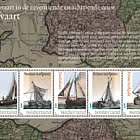
| Shipping in the 17th and 18th Centuries - Peat Shipping |
| Issued: 05.12.2025 |
| ›Netherlands |