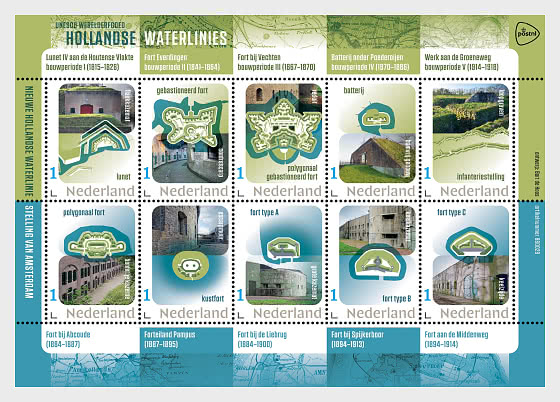
On March 30, 2026, PostNL will issue the Hollandse Waterlinies stamp sheet, featuring photos and maps of 19th- and early 20th-century defensive works in the Netherlands. The Hollandse Waterlinies is the collective name for the Nieuwe Hollandse Waterlinie and the Stelling van Amsterdam. By flooding land during wartime, these defensive lines were able to protect the west of the Netherlands against the enemy.
The Dutch Waterlines stamps bear the value indication 1 for mail up to and including 20 grams with a destination within the Netherlands. The design of the stamps was created by graphic designer Bart de Haas from The Hague.
The New Dutch Water Line and the Defence Line of Amsterdam together form the Dutch Water Lines. This UNESCO World Heritage Site is a 200-kilometer-long defensive line comprising 96 forts, 6 fortresses, and 2 castles. In wartime situations, the west of the Netherlands could be protected against the enemy by flooding wide strips of land up to knee height. This rendered the land impassable for soldiers, vehicles, or horses, while the water remained too shallow for boats.
In 1815, construction began on the New Dutch Water Line as an improvement and expansion of the 17th-century Old Dutch Water Line. A new construction phase followed in 1880 with the creation of the Amsterdam Defence Line. Should the enemy break through the New Dutch Water Line, the Amsterdam Defence Line would serve as the last refuge for the military staff, the government, and the royal family. In addition to the system of sluices, dikes, and canals to flood land, forts were built at passages and other strategic locations.
The New Dutch Water Line and the Amsterdam Defence Line are among the largest military World Heritage Sites in the world, along with the Roman Limes and the Great Wall of China. The New Dutch Water Line was flooded, either wholly or partially, three times due to threats of war: in 1870 (Franco-Prussian War), in 1914–1918 (World War I), and in 1939–1940 (in the run-up to World War II). The Amsterdam Defence Line never saw active service.