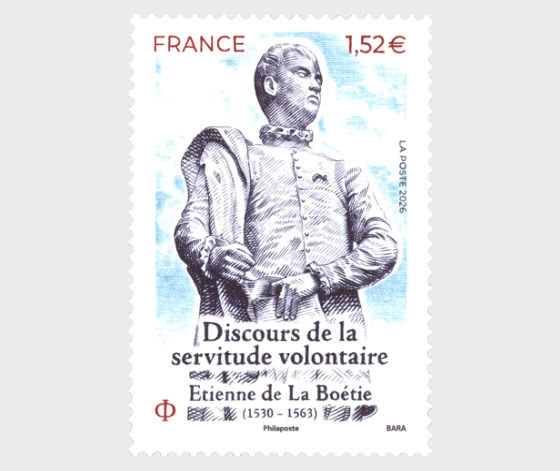
On May 18, 2026, the French postal service, La Poste, issued a stamp in honor of Étienne de La Boétie, author of the famous Discourse on Voluntary Servitude.
In the 16th century, as France was about to be engulfed by the Wars of Religion, Étienne de La Boétie (1530-1563), a close friend of Montaigne (“Because it was him, because it was me”), wrote his Discourse on Voluntary Servitude at the age of only 18. This text, often considered a precursor to liberalism, civil disobedience, and the critique of absolutism, analyzes the mechanisms of political domination.
In it, La Boétie argues that tyranny is not based on force but on the voluntary obedience of individuals. Human beings, naturally free, have forgotten their original state and have become accustomed to submission as if it were natural. They accept servitude out of habit, education, or resignation. Tyrants maintain this submission by offering spectacles, games, food distributions, or by resorting to religion. But the essence of servitude comes "from below," from the very consent of the dominated.
La Boétie describes a pyramid of power: the tyrant surrounds himself with a few close associates who, to serve their interests, rely on others, more numerous, until they subjugate the entire society. Yet, it would only take one link ceasing to obey for the edifice, like a colossus with feet of clay, to collapse: "Resolve to serve no more, and you are at once free." Liberty can be reborn if people break with this habit of serving.
The Discourse, considered explosive, was never published during the lifetime of its author, who was also an advisor to the Parliament of Bordeaux. Dying at the age of 32, La Boétie left behind a work that his friend Montaigne hesitated to publish. It was finally published in 1574, under the title Contr’un, by the monarchomachs, Protestants hostile to the absolute monarchy and who denounced the persecutions suffered in particular during the massacre of Saint Bartholomew (1572).