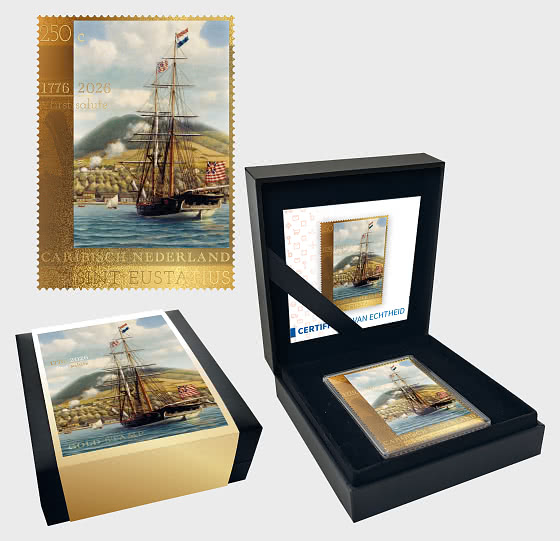
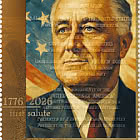
The First Salute is the cannon salute fired on 16 November 1776 at Sint Eustatius from Fort Orange in response to the salute of the American ship Andrew Doria. A few months after the United States Declaration of Independence, this marked the first recognition of the United States by a foreign power.
As a result of the American Revolutionary War, there was a significant demand for weapons and military supplies by the Patriots, who began a large-scale illicit arms trade via Sint Eustatius, exchanging guns and gunpowder for colonial goods such as sugar and cotton. This trade soon became so lucrative for all parties involved that profits on gunpowder reached up to 100% and warehouses in the colony were often so full that excess colonial goods acquired from American merchants were often stored outdoors. American merchants soon bought nearly half of all weapons and ammunition in Sint Eustatius.
In July 1776, thirteen North American colonies had signed the United States Declaration of Independence. On 16 November 1776, the Andrew Doria visited the harbor of Sint Eustatius to load weapons and ammunition. It was the first American ship flying the new American flag (the Continental Union Flag) to enter the harbor. Governor Johannes de Graaff ordered that the ship be received with full honors. After the Andrew Doria fired a salute in greeting, he commanded that it be returned with salutes from Fort Orange. Once docked, he hosted a celebration for the captain and invited all Americans on the island. The Americans accepted the salute as the first recognition of the United States by a foreign power.
In 1939, President Franklin D. Roosevelt presented a plaque to Sint Eustatius, in recognition of the First Salute. It is mounted on the square at Fort Orange at the flagpole. The Roosevelt family (with Dutch roots) was not unfamiliar with the island. In 1759, Adolphus Roosevelt and Elizabeth Groebe had married there.