Serbian Monasteries Listed as Cultural Heritage by UNESCO
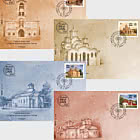
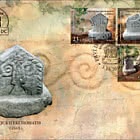
| First Day Cover |

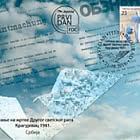
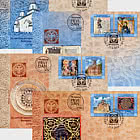
| Maxi Cards |
Mother of God Ljeviška is a church in Prizren, the endowment of king Milutin. It was built from 1306 – 1307 on the remains of a cathedral from 13th century, which was also founded on the site of an older early Christian church. The church is a historic seat of the bishop of Prizren of the Serbian orthodox church. The original construction from 13th century was a three - nave basilica. It had three apses on the east side and a narthex on the west side, in front of which there was a porch.
The church is a historic seat of the bishop of Prizren of the Serbian orthodox church. The original construction from 13th century was a three - nave basilica. It had three apses on the east side and a narthex on the west side, in front of which there was a porch. Having been reconstructed in 14th century, the main nave was turned into a five – dome whole, and the side naves were turned into an ambulatorium. This is an idea which had been already seen at the Church of the Apostles of Thessaloniki: the basis is an inscribed cross with five domes, surounded on three sides by a wide nave. Instead of the porch, a two – storey exonarthex (outside narthex) with a bell tower was built. Side walls were taken from the old church. The central dome lies on four pillars, while the small ones are placed diagonally. The church was built of alternately placed rows of bricks and limestone. The exterior is revived by double and triple windows and niches. The oldest preserved frescoes in the church originate from the third decade of the 13th century. These are scenes of the Wedding at Cana, the Healing of the Blind and the Mother of God Eleusa with Christ the Bread – giver. Today, the first two of them are preserved at the Fresco Gallery of the National Museum in Belgrade, while the third is preserved on the southern pillar of the southern nave of the church. The other frescoes at the Mother of God Ljeviška church are the cycles of great festivals, miracles and parables, as well as the portraits of saints and Serbian historic personalities (Stefan Nemanja, Saint Sava, king Milutin).
It was placed on UNESCO’s World Heritage List in 2006.
Gračanica Monastery is the endowment of king Milutin, his wife Simonida and their son Stefan, built in 1321 and dedicated to the Dormition. The monastery is in the village of Gračanica, 10 km away from Priština. The church of the Gračanica monastery is a construction of five domes having an inscribed – cross basis, and as such belongs to the group of first – class architectural realization of that era. The outside narthex was built at the end of 14th century at the time of Prince Lazar. The period of 14th and 15th century was a period of great spiritual glory of the monastery where hundreds of monks developed very intensive spiritual and artistic activities.
In mid 16th century the monastery had the first printing shop. Later, due to great Turkish oppression, the monastery was deserted and the church was used for the parish purposes. After the World War II, the monastery was renewed by the nuns and it has been a convent ever since.
Today, about 20 nuns who live there deal with icon painting, sewing, agriculture and other monastic obediences. Gračanica is one of the most important monuments of the old Serbian culture. The church is built of hewn stone laid in a pattern of double and triple rows of bricks and has five domes and three apses. It is constructed as an aesthetic, constructional and architectural perfection and is of very harmonious proportions. There are frescoes at the church which represent ancestry of the Nemanjić dinasty (a copy from the Dečani monastery), images of king Milutin and queen Simonida, the daughter of the Byzantine emperor Andronicus II; in the central dome there are frescoes of Christ Pantocrator, the Heavenly Liturgy, prophets and evangelists; the Festival Cycle, the Passion, miracles, stories, the Nativity and the Resurrection of Christ, as well as the scenes from the life of the Mother of God, Saint Nicholas and the Calendar of Saints.
It was placed on UNESCO’s World Heritage List in 2006.
Visoki Dečani Monastery, dedicated to Christ Pantocrator and the Ascension of Our Lord, it is an endowment of king Stefan III Dečanski and emperor Dušan. It is placed south – west of Peć, at the foot of the Prokletije mountain.
The construction of the church of Christ Pantocrator began in 1327 by endowment of the Serbian king Stefan Uroš III Dečanski, and after his death the endowment was taken over by his son, emperor Dušan, during whose reign the construction of the monastery was finished, in 1335. The main architect was fra Vita from Kotor, and the monastery, which got its name Visoki (’Tall’) due to unusual proportions for that period (36 metres long and 30 metres tall), was painted from 1347 – 1348 and represents the biggest Serbian medieval monument. With its constructional complexity it represents a harmonious permeation of the western elements – Romanesque and Gothic, and the eastern – Byzantine style with the already existing tradition of the Serbian art.
It was placed on UNESCO’s World Heritage List in 2004.
Patriarchate of Peć – one of the most important monuments of the Serbian culture is the monastery of the Patriarchate of Peć, which is, as a church complex, near Peć. It consits of the church of Holy Apostles, built around 1250, the church of St. Demetrius, built around 1320, the temple of the Virgin Hodegitria and the church of St. Nicholas both built around 1330. From its construction in XIII century, the church was a seat to the Serbian patriarchs, but also the meeting place of learned people and gifted artists. It is believed that the construction of the church of Holy Apostles was designed and commenced by St. Sava, the abbot of Studenica monastery and the first archbishop of the Serbian autocephalous Orthodox church. Today, Patriarchate of Peć is not only an old center of the Serbian church, but aslo an important part of the Serbian spirituality and the place which cherishes great Serbian historic and artistic heritage.
It was placed on UNESCO’s World Heritage List in 2006.
Serbia - Recommended stamp issues



WOPA+ recommended stamp issues

| Avatar - Fire and Ash |
| Issued: 03.12.2025 |
| ›New Zealand |
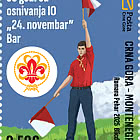
| 50th Anniversary of the Founding of the 24th November Bar Scout |
| Issued: 24.11.2025 |
| ›Montenegro |
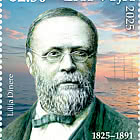
| Krisjanis Valdemars |
| Issued: 02.12.2025 |
| ›Latvia |
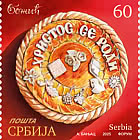

| Sign Language - Good |
| Issued: 02.12.2025 |
| ›Bosnia and Herzegovina - Republic of Srpska |

| In Memory of the Fallen and Murdered on October 7, 2023 |
| Issued: 08.10.2025 |
| ›Israel |

| Annual Collection Folder (New York) |
| Issued: 05.12.2025 |
| ›United Nations |
| Year Set |
| Issued: 24.11.2025 |
| ›Isle of Man |
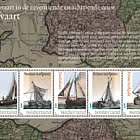
| Shipping in the 17th and 18th Centuries - Peat Shipping |
| Issued: 05.12.2025 |
| ›Netherlands |