Minerals And Rocks
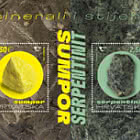
| Miniature Sheet |
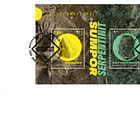
| First Day Cover |
The science that explores the formation and classification of rocks is called petrology. Rocks build the lithosphere, a rocky layerthat encompasses the Earth's crust and the upper part of the Earth's mantle. In terms of their origin, rocks are classified as igneous, sedimentary and metamorphic. Igneous rocks are formed by crystallization or solidification of magma in the interior of the Earth or lava on the surface of the Earth. Sedimentary rocks are created on the surface of the Earth by sedimentation of material formed by the wear of already existing rocks by the action of water, wind or ice, or by sedimentation of residues of organisms, or by chemical sedimentation from supersaturated solutions. Metamorphic rocks are formed by transformation of already existing rocks, whether igneous, sedimentary or even older metamorphic rocks, during which the recrystallization of minerals occurs in a solid state due to the influence of temperature, pressure and fluids. Igneous rocks make up about 95% of the lithosphere, whereas the other two types of rock are only 5% of the lithosphere. Rocks are aggregates of one or more minerals, and a mineral is a natural solid formed by geological processes, with a specific chemical composition and crystal structure, stable under certain temperature and pressure conditions. Minerals are made up of atoms interconnected by different types of chemical bonds that are regularly repeated in space, forming a crystal lattice. Minerals can occur as crystals - as a homogeneous, regular geometric solid with some degree of symmetry, which is a reflection of their regular internal composition, but they occur even more often in nature as different aggregates. All known minerals are divided into classes according to their chemical composition and structural characteristics (I - native elements, II - sulfides, III - sulfosalts, IV - oxides and hydroxides, V - halides, VI - carbonates, VII - nitrates, VIII - borates, IX - phosphates, arsenates and vanadates, X - sulfates, XI - tungstates and molybdates, XII - silicates and XIII - organic compounds) that are defined by a dominant anion or an anion group. Minerals that have the same dominant anion or anion group have many similarities and often occur together in similar geological environments. The scientific study of the chemical composition, crystalline structure and physical properties of minerals, as well as the study of the formation of minerals and their classification, distribution and their use, is called mineralogy.
Sulfur - Radoboj, Hrvatsko zagorje
One of the oldest known chemical elements is sulfur, and when it appears in nature in its elemental form, it is a mineral from the class of native elements that belongs to the group of non-metals. Native sulfur is most often formed near volcanic vents and fumaroles by sublimation from a stream of hot gases, and smaller quantities can be produced by the consumption of sulfide and sulfate minerals. It crystallizes in the orthorhombic system and often appears in the form of dipyramidal crystals, or as a massive and sometimes powdery aggregate. Its color is typically yellow, and it can also be yellow-brown, reddish, greenish to gray, while its streak is always white. On crystal surfaces, sulfur has a strong diamond shine, and at the fracture its shine is resinous or waxy. Sulfur has an incomplete cleavage by three plane systems, and its fracture is conchoidal to irregular. It is of low hardness and relatively low density.
Sulfur is the tenth most abundant element in the universe, where it is formed in the interior of massive stars by the fusion of silicon and helium, while in the form of sulfides it appears in many types of meteorites, especially ordinary and carbon chondrites. On our planet Earth, sulfur is even more common, and as the fifth most common element, it appears either as an integral part of sulfide and sulfate minerals, or as a native element. More than 1000 different types of minerals are known to contain sulfur in their composition, which is due to the ability of sulfur to form compounds with numerous other chemical elements.
In his book Specijalna mineralogija [Special Mineralogy] Fran Tućan states the following for sulfur: “In Croatia, the most important site is in Radoboj near Krapina, where it is found in the Sarmatian marl... It developed in two layers. In the upper layer, which is composed of blackish flaky shale, ..., sulfur is scattered in clumps, which are as big as a walnut, an apple and a human head. Beneath that layer lies a layer of sandy shale full of insect and plant fossils, and underneath it a layer with sulfur, which is mixed with gray shale matter.” Sulfur was discovered in Radoboj at the beginning of the 19th century, which began the mining history of the region, and the exploitation of sulfur using the world-famous Radoboj machine lasted for more than a century.
Serpentinite - Roknić strana, Bović, Banovina
Serpentinite is a rock that consists for the most part of one or more minerals from the serpentine group - phyllosilicate minerals that occur naturally as dense scaly or fibrous aggregates formed by the low-temperature hydrothermal process of olivine or pyroxene mineral exchange in primary ultrabasic rocks. It is a metamorphic rock of green to dark green color, mesh or lattice texture that resembles snake skin, which is why it was named after the Latin word serpens, which means snake.
The process by which these changes in minerals occur is called serpentinization, and it takes place most often deep on the seabed on the borders of tectonic plates at temperatures from 200°C to approximately 500°C and under atypical chemical conditions with the presence of water as an oxidizing agent. During serpentinization, the rock absorbs large amounts of water, resulting in an increase in volume, a decrease in density and destruction of the original texture of the rock, and the release of gaseous hydrogen, which plays a significant role in the formation of methane and hydrogen sulfide, together with which it is the main source of energy for deep-sea chemotrophic microorganisms.
Serpentinites are very often an integral part of ophiolite zones, rock masses that represent the remnants of the oceanic crust and the upper part of the Earth's mantle, formed in the oceanic environment near mid-ocean ridges, or subduction zones, and have reached land by tectonic movements. It is interesting to mention that the name ophiolite comes from the Greek words ophis and lithos, which mean snake and rock, respectively, due to the fact that it contains serpentinite.
In the Banovina area, serpentinites appear as parts of older metamorphic and ultramafic complexes that are associated with the remains of former oceanic lithospheric plates. The area belongs to the Central Dinaric Ophiolite belt that stretches from Banovina through Bosnia and Herzegovina to Serbia and represents part of the ancient Neotethys Ocean that began to form about 250 million years ago by the separation of the supercontinent Pangaea into Laurasia and Gondwana. That ancient ocean disappeared about 50 million years ago when the Indian tectonic plate collided with the Eurasian plate, creating the Himalayan mountain range.
Biserka Radanović-Gužvica
Croatian Natural History Museum
Croatia - Recommended stamp issues








WOPA+ recommended stamp issues

| Avatar - Fire and Ash |
| Issued: 03.12.2025 |
| ›New Zealand |

| 50th Anniversary of the Founding of the 24th November Bar Scout |
| Issued: 24.11.2025 |
| ›Montenegro |

| Krisjanis Valdemars |
| Issued: 02.12.2025 |
| ›Latvia |


| Sign Language - Good |
| Issued: 02.12.2025 |
| ›Bosnia and Herzegovina - Republic of Srpska |

| In Memory of the Fallen and Murdered on October 7, 2023 |
| Issued: 08.10.2025 |
| ›Israel |


| Annual Collection Folder (New York) |
| Issued: 05.12.2025 |
| ›United Nations |

| Year Set |
| Issued: 24.11.2025 |
| ›Isle of Man |

| Shipping in the 17th and 18th Centuries - Peat Shipping |
| Issued: 05.12.2025 |
| ›Netherlands |