Matariki is the Māori name for the entire star cluster known internationally as the Pleiades. Within Māori knowledge systems, Matariki is understood not simply as a group of stars, but as a whānau, with Matariki herself recognised as the mother, and the surrounding whetū (stars) as her children.
Each whetū carries its own role, responsibility, and relationship to the natural world and to human life. Together, they provide a framework for reflection, remembrance, seasonal practice, and planning for the year ahead - linking the wellbeing of people directly to the health of the environment.
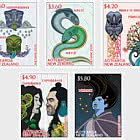
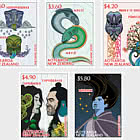
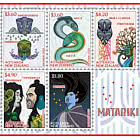
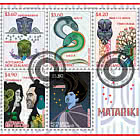
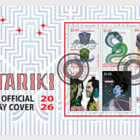
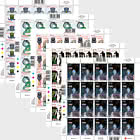
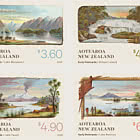
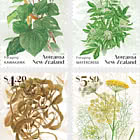
Designed by David Hakaraia (Ngāpuhi, Ngāti Paoa), the Matariki 2026 stamp issue depicts his visual interpretations of all nine of the stars in the Matariki star cluster.
Set of five mint stamps
$3.60 Waipunarangi and Ururangi - Waipunarangi is associated with rain and atmospheric moisture. Its name translates to “water that pools in the sky”. Persistent winter rains that cause water to pool on the land are referred to as Matariki tapuapua, highlighting the seasonal shift toward colder, wetter conditions.
Ururangi is the whetū of the winds. It determines the nature and character of the winds for the year ahead, influencing weather patterns and environmental conditions.
$3.60 Waitī and Waitā - Waitī is linked to freshwater environments and the life within rivers, streams, and lakes. Waitā represents the ocean and the food gathered from the sea. Waitī is linked to freshwater environments and the life within rivers, streams, and lakes. Its influence is reflected in the proverb: “Ka kitea a Matariki ka rere te korokoro”. Korokoro (lamprey) migrate from the ocean into freshwater during late winter and early spring, a movement that aligns with the rising of Matariki and the appearance of Waitī.
Waitā represents the ocean and the food gathered from the sea. It is said that when Matariki sits low on the horizon above the ocean, it exerts influence over tides and floodwaters, reinforcing the deep relationship between celestial movements and marine systems.
$4.20 Pōhutukawa and Hiwa-i-te-rangi - Pōhutukawa, a child of Matariki, is the whetū connected to those who have passed away since the previous rising of the cluster. It anchors Matariki to remembrance, grief, and the continuing relationship between the living and the dead. According to Māori belief, when a person dies their spirit travels along Te Ara Wairua, the pathway of spirits, leading north to Te Rerenga Wairua. There, spirits descend the roots (aka) of the ancient pōhutukawa tree and enter the underworld at Maurianuku. As Matariki rises, people traditionally call out the names of the dead and weep, acknowledging Pōhutukawa’s role in holding memory and guiding spirits onward.
Hiwa-i-te-rangi is associated with aspiration, promise, and abundance. It is to this whetū that people send their hopes, wishes, and intentions for the year ahead. As a child of Matariki, Hiwa-i-te-rangi embodies forward-looking energy encouraging renewal, ambition, and faith in what is yet to come. This practice is often likened to wishing upon a star, grounded firmly in Māori cosmology and seasonal renewal.
$4.90 Tupuānuku and Tupuārangi - Tupuānuku is associated with food grown in the ground, including cultivated crops and wild foods such as kūmara, potatoes, and roots. This relationship is reflected in the whakataukī: “Hauhake tū, ka tō Matariki” (The harvest is completed when Matariki sets). When Matariki disappears into the western sky in late autumn, it signals the end of harvesting and the approach of winter.
Tupuārangi governs food sourced from above the ground, particularly birds and fruit from trees. During the time of Matariki, birds such as kererū were harvested, cooked, and preserved in their own fat. This practice is remembered in the saying: “Ka kitea a Matariki, kua maoka te hinu” (When Matariki is seen, the fat is rendered). Tupuārangi connects Matariki to abundance from the forest canopy and the sky.
$5.80 Matariki - Matariki is the central whetū and is regarded as the mother of the Matariki constellation. In Māori tradition, Matariki was taken as a wife by Rehua, the paramount chief of the heavens (the star Antares), who sits apart from the Matariki cluster. As the mother, Matariki is closely associated with wellbeing, health, and collective vitality.