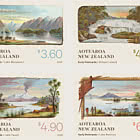
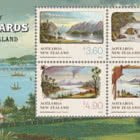
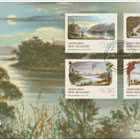
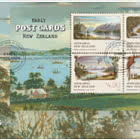
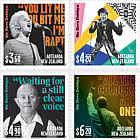
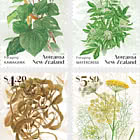
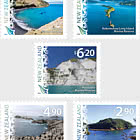
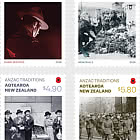
The New Zealand Department of Tourist and Health Resorts was a government department established on 1 February 1901 and aimed to promote New Zealand’s natural environment and tourist services both within the country and overseas. As part of their promotional strategy, they released photographs, guidebooks, pamphlets, and these original postcard designs.
The designs on these postcards reflect the overarching focus for the tourism industry at that time. They showcased lakes, rivers, mountains, forests and geysers through beautiful colour illustrations by British-born New Zealand artist Benoni White. The postcards were also embellished with drawings depicting native plants, scenes of everyday life in New Zealand and Māori taonga.
The postcards featured in the 2026 stamps are reproductions from either the 1902 or 1904 series. Both were chromolithographs printed in Whanganui, New Zealand by A D Willis. The address side of the cards issued in 1902 featured Māori carvings, the royal arms and three canoes, lithographed in red. The 1904 cards were a reissue with Mount Earnslaw and Lake Wakatipu on the address side.
New Zealand tourism began long before the establishment of the New Zealand Tourist Department and Health Resorts. Early tourists travelled here on steamships, particularly following improved access when the Suez Canal opened in 1869. They were also thought to have been inspired by a visit by Prince Alfred, the Duke of Edinburgh, in 1870. Wealthy tourists often came as part of a world tour, with their stop here focused on seeing some of New Zealand’s most scenic spots including Milford Sound, the Whanganui River and the Rotorua thermal area – known then as ‘the Hot Lakes District’.
Today, postcards remain an important part of tourism. Whether purchased as a keepsake, gift, or for writing to loved ones, they continue to depict the most picturesque locations or represent the ways in which a country or place would like to be seen by the world.