Romanian Postage Stamp Day is celebrated on July 15th, in accordance with Law No. 62/2024. This date marks the issuing of the first Romanian postage stamp, the ‘Capul de bour’ (Bull’s Head), printed in Iași on July 15th, 1858, under the auspices of the Royal Post Office of the Principality of Moldavia. Alongside other national symbols, the postage stamp has become a defining symbol of Romania’s social, political, economic, and cultural life. Over time, it has promoted Romanian figures, events, and achievements both domestically and internationally. Thus, the Romanian postage stamp has established itself as a valuable landmark of the nation’s cultural and spiritual heritage.
Romfilatelia and Romanian Post introduce into circulation on Wednesday, July 15th, 2026, the philatelic issue entitled ROMANIAN POSTAGE STAMP DAY. HISTORICAL FAMILIES: THE BRĂTIANU FAMILY, to pay tribute to Romania’s Uncrowned Dynasty, as it was called by Academician Ioan-Aurel Pop, President of the Romanian Academy from April 2018 to April 2026, who kindly contributed the following introductory text dedicated to the Brătianu family:
The Brătianu family played a role in shaping the Romanian national agenda during the 1848 Revolution and subsequently contributed to each of the three stages of modern state-building: 1859, 1877, and 1918. The first prominent figures were Dumitru and Ion, leaders of the revolution. It was Ion C. Brătianu who personally travelled to Düsseldorf to negotiate successfully the accession of Prince Carol to the Romanian throne. He later co-founded the National Liberal Party and served as Prime Minister of Romania during the period in which the country proclaimed and secured its independence (1876–1888). His government achieved a series of landmark accomplishments, including the international recognition of Romania’s independence, the establishment of the National Bank of Romania, the proclamation of the Kingdom of Romania, the founding of the newspaper ‘Universul’, the attainment of autocephaly for the Romanian Orthodox Church, and the construction of the railway network, among others. His 12-year tenure as head of government was also referred to as I. C. Brătianu’s ‘vizierate’, alluding to the omnipotence of the great Turkish viziers (a sort of prime minister), but also expressing admiration for his determination and tenacity. Ion I. C. Brătianu, the son of the former, served as prime minister when Greater Romania was formed and championed the union of all Romanians. He negotiated with heads of state and government for international recognition of the union, introduced universal suffrage, carried out agrarian reform, and was the architect of the 1923 Constitution, one of the most democratic in Europe. As a historian, Gheorghe I. Brătianu was deeply inspired by his forebears and by all Romanians. The Brătianu family of the Florica estate had drawn up the country’s blueprint and, ultimately, had built the country itself, and some had even come to present it to the world through its history. Gheorghe I. Brătianu, alongside C. C. Giurescu and P. P. Panaitescu, was part of the generation of brilliant students of Nicolae Iorga, whom he succeeded as the leading figure among Romanian historians at the Institute of Universal History (later renamed the ‘Nicolae Iorga’ Institute of History). Through the topics he addressed - the history of the Black Sea, the history of the Estates General, the formation of Romanian unity, the formation of the Romanian people and the Romanian language, etc.- Gh. Brătianu came to be regarded as the most important Romanian medievalist. Vintilă and Constantin (Dinu) led the National Liberal Party and the country under extremely difficult conditions (the economic crisis, the rise to power of Soviet Stalinist communism) and contributed significantly to the emergence of interwar Romania. Some family members, such as Constantin I. C. and Gh. I. Brătianu, ended up in communist prisons, sacrificing their lives in defence of democratic Romania. The Brătianu family deserves our eternal gratitude.
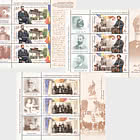
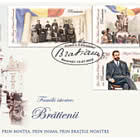
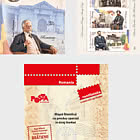
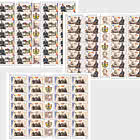
The philatelic issue consists of three postage stamps, a perforated souvenir sheet, a First Day Cover and a philatelic folder containing special products in a limited run printing.
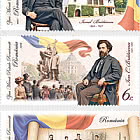
The postage stamp with the face value of Lei 6 features Ion C. Brătianu (1821-1891), and the background depicts the monument in Bucharest dedicated to him, which was designed by architect Petre Antonescu and created by French sculptor Ernest Henri Dubois, after winning an international competition held in 1900. It was inaugurated on May 18th, 1903, at the intersection of Colței Boulevard (now I. C. Brătianu Boulevard) and King Carol I Boulevard, marking the twelfth anniversary of Ion C. Brătianu’s death. The monument was funded through a public subscription.
A prominent figure in nineteenth-century Romanian political life and an honorary member of the Romanian Academy, he contributed through his extensive work to the establishment of the modern Romanian state. He played a central role in the efforts to unify the various liberal factions into a single political party, the National Liberal Party, and was elected its first president. He was at the forefront of the historical events that shaped the destiny of the Romanian people: the Revolution of 1848, the Union of the Principalities, and the achievement of national independence. He held the longest term as Prime Minister of Romania, until the communist era. During his terms in office, important measures were adopted to modernize and strengthen the Romanian state.
The postage stamp with the face value of Lei 5.50 features Ion I.C. Brătianu, or Ionel Brătianu (1864 – 1927), as he was also known, a diplomat, engineer, and politician who played a pivotal role in the Great Union of December 1st, 1918, and, more broadly, in the political life of modern Romania. Ionel Brătianu was leader of the National Liberal Party for 19 years, served five times as President of the Council of Ministers, more than any other Romanian politician, twice as Minister of Foreign Affairs, three times as Minister of the Interior, and twice as Minister of National Defence. In the background, the façade of the Brătianu National Museum, housed in Villa Florica in the town of Ștefănești, Argeș County, is depicted in a stylized manner.
The postage stamp with the face value of Lei 16 depicts a photo of the members of the Brătianu Family: center (seated): the family patriarch, Ion C. Brătianu, with his white beard, to his left (seated): his wife, Pia Brătianu, the young people standing and seated around them: their children – Ionel (Ion I.C.) Brătianu, Vintilă Brătianu, Dinu (Constantin) Brătianu – along with their sisters, including Sabina (Brătianu) Cantacuzino.
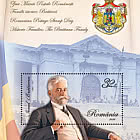
The perforated souvenir sheet of the issue depicts, in its stamp with the face value of Lei 32, the Ionel Brătianu’s, figures and in the background, a scene from the Coronation in Alba Iulia, on October 15, 1922, of the Kings of Greater Romania.
Romfilatelia thanks Academician Ioan-Aurel Pop, as well as representatives of the Library of the Romanian Academy, the National Archives of Romania and the Brătianu National Museum for their documentary support provided in the development of this postage stamp issue.