EUROMED. Traditional Mediterranean Mosaics. Roman Villa of La Quintilla. Lorca (Murcia)
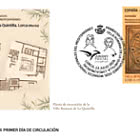
The Postal Union for the Mediterranean was established in Rome on March 15, 2011, by 14 postal operators from the Mediterranean region under the umbrella of the Universal Postal Union (UPU). Among its numerous initiatives, one of the most anticipated is the issuance of a stamp within the Euromed Postal series, in which a theme is chosen and all member countries of this organization submit their designs freely. In 2026, the chosen theme was Traditional Mediterranean Mosaics, and Correos (the Spanish postal service) selected the Roman Villa of La Quintilla, located in Lorca (Murcia).
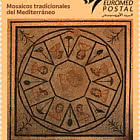
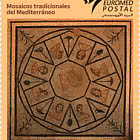
The stamp features the MOSAIC OF NINE FACES: Among the mosaics that pave the different rooms of the villa, the one in room 28 stands out. It consists of nine female busts that appear within rectangles, which are in turn inscribed within an octagon. The busts are styled in a bun held by a hairnet and crowned with a diadem, perhaps representing the Muses.
To learn more about the Villa, we will now list its different spaces:
THE VILLA
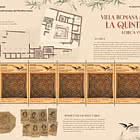
The Roman villa of La Quintilla is one of the best known and most important in the Region of Murcia, located 4 km from Lorca, at the foot of the Cejo de los Enamorados (Lovers' Hill). The villa's layout is developed on two terraces. The lower terrace houses the work and storage area, or pars rustica, with a large courtyard surrounded on its south and west sides by square rooms. The residential area, or pars urbana, is organized around an atrium with an impluvium and a large peristyle with a central pool decorated with aquatic motifs, surrounded by several rooms paved with mosaics and with walls decorated with murals. The ornamental program indicates that the complex dates from the 2nd century AD.
IMPLUVIUM MOSAIC
Access to the villa was through a tetrastyle atrium, in the center of which was the square impluvium. To the south of the atrium were small baths, and to the east, stairs led up to the peristyle on an upper terrace.
The impluvium was paved with a mosaic made of white, black, and red tesserae, forming a shield of curvilinear triangles that decrease in size towards the center of the circle. A circular braid framed by red tesserae was depicted in the center, while the corners of the impluvium were decorated with two peltae and two knots.
MURAL PAINTINGS
Among the paintings that decorated the villa, those from room 35 stand out. This room was located in the northwest corner of the villa's peristyle. The restoration of the panel has revealed the composition of this mural painting, which consists of green panels 1.48 meters wide framed by red rectangles and 12-centimeter-wide yellow interpanels. The decoration of these interpanels features a green vegetal candelabra with pomegranates and small birds. At the bottom of the painting is a mottled wainscoting with green, red, and yellow colors arranged randomly to imitate marble. The wall meets the mosaic floor with a molding shaped like a dove's crop, while the wall meets the ceiling with a molded cornice approximately 6 centimeters high.
LUNCHLIGHT FOUND AT THE VILLA
The materials recovered in the archaeological excavations of the La Quintilla villa are very scarce, as the villa's abandonment is attributed to the possible relocation of its owner. We have only a few ceramic remains, most of which date from the final phase of the villa's occupation. Among these materials, the high number of ladles stands out, each with a flat handle at one end, as well as locally produced oil lamps. The oil lamp in the image was left in the peristyle during the first half of the 3rd century AD, when the villa was abandoned.