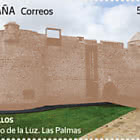
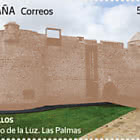
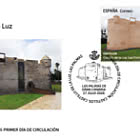
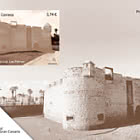
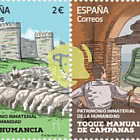
The Castillo de La Luz is the oldest defensive fortress in Gran Canaria, its location coinciding with the founding of the Royal City of Las Palmas in June 1478. At the end of the 15th century, the original structure consisted of a three-story, quadrangular enclosure of medieval design. A unique feature of this fortress is its construction by alluvial deposits, carried out in three phases. The initial phase, centered on the so-called Torre Fajardo, was followed in 1547 by an artillery barrier and, finally, in 1563, by the outer wall. In the mid-20th century, the Castillo de La Luz was declared a Site of Cultural Interest.
After decades of various proposals, at the end of the 20th century, the decision was made to convert it into a museum, a project awarded to the architectural firm of Fuensanta Nieto and Enrique Sobejano, specialists in the adaptation of archaeological and historical buildings. The new art space was inaugurated in January 2014 by the then Prince and Princess of Asturias, Felipe and Letizia. During the building's restoration as a museum, parts of the original structure were discovered, hidden for five centuries due to the infill used in the construction of the outer wall in the 16th century.
In the architectural renovation undertaken by Nieto-Sobejano, which has housed the Martín Chirino Foundation for Art and Thought since 2015, three original materials were incorporated, ultimately reinforcing the inherent value of the historic walls. These are weathering steel, used in all non-structural elements, including the surrounding fence that protects the complex like an ark; white concrete for the new structural elements, always adhering to the principle of not disturbing the original stone; and white limestone for the castle's interior and exterior floors.