Spain faces a truly exceptional astronomical opportunity. Between 2026 and 2028, our country will be the stage for three highly significant solar eclipses: a total eclipse on August 12, 2026, another total eclipse on August 2, 2027, and an annular eclipse on January 26, 2028. This set of phenomena, known as the "Eclipse Trio," is an extraordinarily rare occurrence.
Total solar eclipses are among the most extraordinary natural phenomena that can be observed from Earth. For a few minutes, the Moon completely obscures the solar disk, transforming the landscape in a way that is difficult to describe: the light dims, the temperature drops, stars and planets appear in broad daylight, and the solar corona, normally invisible, is revealed in all its splendor. This combination of beauty, emotion, and scientific value has fascinated humanity since antiquity.
Furthermore, throughout history, eclipses have played a significant role in the advancement of astronomy and physics. They have allowed scientists to study the Sun's outer atmosphere, discover new phenomena, and test fundamental theories.
Thanks to this exceptional "Trio of Eclipses," Spain has become one of the world's leading centers for eclipse observation, attracting scientists, enthusiasts, and visitors from numerous countries. But the true value of these eclipses extends far beyond the astronomical phenomena themselves and the unforgettable experiences they provide. The "Trio of Eclipses" represents a unique opportunity to promote scientific culture, encourage young people to pursue careers in science, promote the protection of the night sky, and consolidate astrotourism as an engine of sustainable development in many regions.
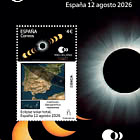
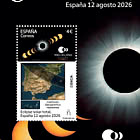
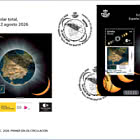
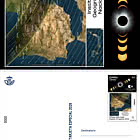
The image reproduces a total solar eclipse along with the logo of the Trio of Eclipses, created by the Government of Spain to provide a common visual identity for the three phenomena, thus reinforcing their public recognition and conveying the idea that they constitute a unique scientific, cultural, and tourist opportunity. The map shows the strip of the Iberian Peninsula from which the solar eclipse of August 12, 2026, will be visible as a total eclipse. The contours in the strip indicate the duration of totality according to calculations made at the National Astronomical Observatory (National Geographic Institute, Ministry of Transport and Sustainable Mobility).