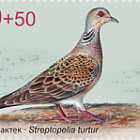
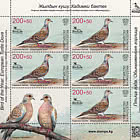
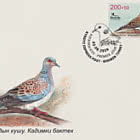
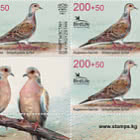
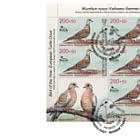
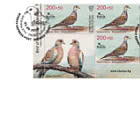
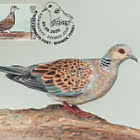
On August 3 the Ministry of Digital Development and Innovative Technologies of the Kyrgyz Republic puts into circulation a Kyrgyz Express Post postage stamp: "Bird of the Year (VIII). The European turtle dove".
The European turtle dove (Streptopelia turtur ) is a species of bird in the pigeon family (Columbidae). It reaches a size of 26 to 29 cm and weighs about 300 g. The plumage of this beautiful, slender bird is reddish-brown and black on the uppersides of its wings, black and white on the sides, and white underneath. Its breast has a reddish tint. Its neck has a pattern of blue and black stripes. The bird is timid and cautious, its flight is characterized by speed and maneuverability. The Latin species name derives from the bird’s distinctive cooing, resembling a soft rhythmic purring sound "turr, turr, turr." The European turtle dove feeds on plant seeds, often various weeds, as well as cereal shoots and invertebrates.
The European turtle dove is a migratory species, wintering on the African continent. It arrives in Kyrgyzstan in late April to mid-May in small flocks of several dozen birds.
In the wild, turtle doves' natural enemies are birds of prey – hawks, falcons, owls; among mammals are the stone marten and sometimes squirrels, which are capable of raiding nests with eggs and small chicks. Unfortunately, humans have significantly contributed to the decline in the turtle dove’s population.
At present, the European turtle dove is included in the IUCN Red List with the status of a vulnerable species. Its population has declined sharply due to hunting, habitat loss, intensive agriculture, and the use of pesticides. The conservation of the species requires strengthened international cooperation, the identification and protection of key breeding and wintering sites, as well as a ban on hunting.
It is interesting to note that in the cultures of many peoples, the turtle dove is a symbol of peace, love, and purity.
KEP hopes that this postage stamp issue will contribute to the protection of the biological diversity of Kyrgyzstan, of which the European turtle dove is an integral part.
As always, KEP expresses its sincere gratitude to ornithologist Sergey Kulagin, PhD in Biological Sciences, for his valuable advisory assistance in the preparation of this postal issue. The charitable surcharge from the sale of the new KEP stamp will be transferred to the fund of the KWCS.