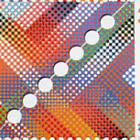
Viera Kraicová (5th July 1920, Modra – 29th April 2012, Bratislava) is one of the most significant figures in Slovak painting of the second half of the 20th century. The most important period in the development of her work was the 1960s when she experienced nothing short of an explosive surge in creativity. Kraicová’s programme of spontaneous painting extended to radical and unique approaches: it was based on the recasting and intermingling of diverse stimuli from lyrical and gestural abstraction, while combining the arrangement of figures with abstract expression in a unique way. In addition to oil paintings, she also devoted herself to small-scale spontaneous tempera paintings, almost until the end of her life. It is these paintings that represent a unique chapter in her body of work.
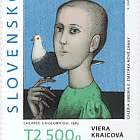
The reproduced works date from the 1980s when, after 1972, her approach to painting changed: she began to refine the morphology and contours of her figural imagery; she wanted to define for herself the category of engagement as humanistic participation. Through the poetic and imaginative veil with which the painter tried to shroud them, her paintings would radiate a meditative and mysterious atmosphere. Boy with a Dove (1983), from the collection of the Ernest Zmeták Art Gallery in Nové Zámky, is a typical example of her portrait work. Her favourite themes included children, for whom she illustrated several books. The figures were characterised by an intrinsically monumental sculptural form, often emphasising subtle and delicate hand gestures. Similarly, she created still life paintings based on simple compositional and thematic relationships, magical paintings full of contemplation and quiet solitude.
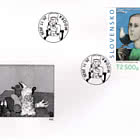
The work reproduced on the surcharge FDC is The Ballad of a Blackbird (1986-1987) from the collection of the East Slovak Gallery in Košice.
It is as though she needed to metaphorically “infuse intimacy” into the void through objects, making use of a “surrealist” montage of various props and elements. In this type of work, she put her admiration for Renaissance painting to good use, fusing her brilliant sense of composition and drawing with a refined sense of colour. “Hands and a face, a face and a head, a head and a figure, a man, people, nature. So much excitement, beauty and mystery,” she commented laconically on her work from the 1970s and 1980s.
Katarína Bajcurová