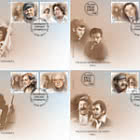
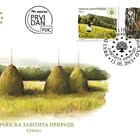
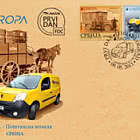
The entire Christian world celebrates the Nativity of Chirst holidays on 25th December. However, three Orthodox Patriarchates - Jerusalem, Russian and Serbian, count the time according to the Julian calendar, and their believers, due to the difference of 13 days, celebrate Christmas on 7th January.
Christmas is considered as one of the most important and joyful Christian holidays, and its message is message of peace and love. Christmas in Serbia is commemorated three days. This is, above all, a family holiday, marked with numerous ancient traditions. On the eve of Christmas, so-called Badnji Dan (Day before Christmas), Badnjak (an oak-tree yule log) is brought into the house, a vigil lamp is lighted, and straw scattered across the floor, together with some sweets, prunes, walnuts, sugar cubes and coins hidden. The straw is there to symbolise the Nativity scene, the yule log is a symbol of longevity and steadiness of Christianity, and the warmth of love that Christ brings to us by His birth and arrival to the Earth. On the Christmas day, early in the morning, the church bells toll and announce the arrival and birth of Christ. The people go to church to the Christmas Liturgy and greet one another: “Christ is Born!”, answering: “He is truly Born!”
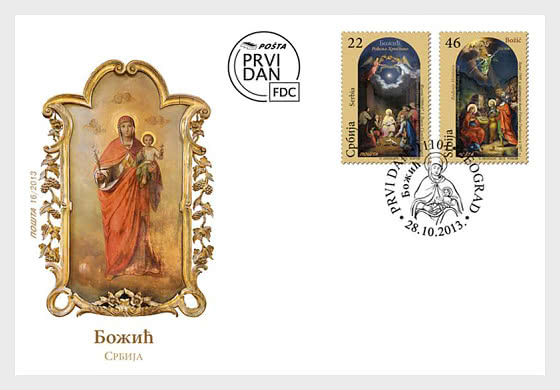
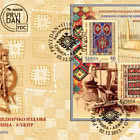
The stamps and envelope show icons from temples of the Serbian Orthodox Eparchy of Banat, found in Vršac and Bašaid. The Serbian Orthodox Church of the Transfer of the Remains of the Holy Father Nikolaj in the village of Bašaid, municipality of Kikinda, was erected in the style of classicism, between 1831 and 1833, during the time of the Metropolitan of Karlovci Stefan Stratimirović. Its interior is decorated by the works of the renowned Serbian painter Pavle Simić, created between 1862 and The Cathedral Church of Saint Nikolaj in Vršac was raised from the foundations between 1783 and 1785, on the location of an earlier temple from 1728. The iconostasis and pulpit, and later the choir and liturgical fans were cut by Aksentije Marković between 1787 and 1797, and in 1803. The iconostasis, choir, thrones and pulpit were painted by Pavel Đurković between 1804 and 1808, and the adaptation of Đurković’s icons on the iconostasis was undertaken in 1865.
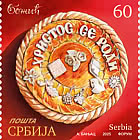
The motif on the nominal 22.00 RSD stamp: The Birth of Christ, an icon from the iconostasis of the Church in Bašaid, the work of Pavle Simić (1866-67); the motif on the nominal 46.00 RSD stamp: The Birth of Christ, an icon from the iconostasis of the Cathedral Church in Vršac, an adaptation of the icon by Pavel Đurković (1807); the motif on the envelope: Throne Icon of the Holy Mother of God with Christ from the Church in Bašaid, (1863).