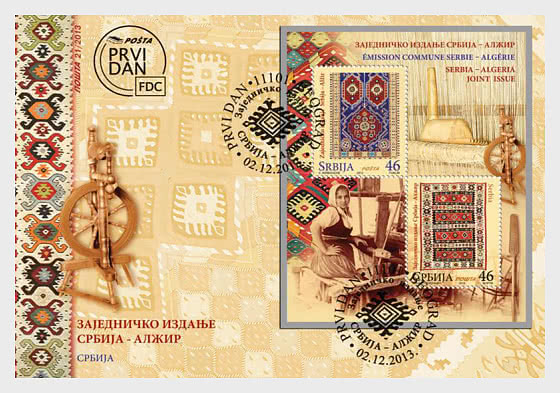
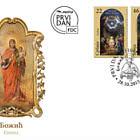
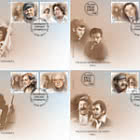
Issuing of joint postal stamps of the two countries contributes to deepening and refining of their relations. Serbia and Algeria have found their tangential point in their cultural heritage in the field of ethnography.
Algerian carpets - The skill of carpet weaving in the territory of North Africa dates back to the Stone Age. It is believed that the Berbers, nomadic people from the North Africa, first started hand weaving with sheep wool and camel hair that were used for making robes, rugs, carpets and other items. Аll fabrics of more than two meters are known as carpets and serve as floorcloths, while the rugs are shorter and they have multiple purpose - hanging on the walls as decoration, used in prayer or serving as mats in nomadic tents. Even today, in Algeria, rugs and carpets are made using traditional method - hand weaving and knot making. The value of the carpet is determined by the beauty of the motifs and number of knots, which can reach up to 250.000 per square meter. The National Museum of Traditional Skills and Crafts in Algeria houses one of the largest and most valuable collections of Algerian carpets.
The Pirot carpets are unique in the world for their lack of a reverse side, as they have two identical fronts. They are made only of high-quality wool of indigenous breed of sheep grazing in the Balkan mountains. The best-quality wool, hand-span and very thinly woven, was selected for the weft of Pirot carpets that at the beginning were used as a horse cover placed beneath the saddle. For their ornate look and rich decorations used by the weaving women to embellish the carpets, they have moved to the house floors and walls and were used for various purposes. The Museum of Applied Art in Belgrade has more than 120 of hand-woven unique Pirot carpets in its collection. They were created in the period between the end of the eighteenth and the beginning of the twentieth century, considered as the golden age in creation of the Pirot carpets.