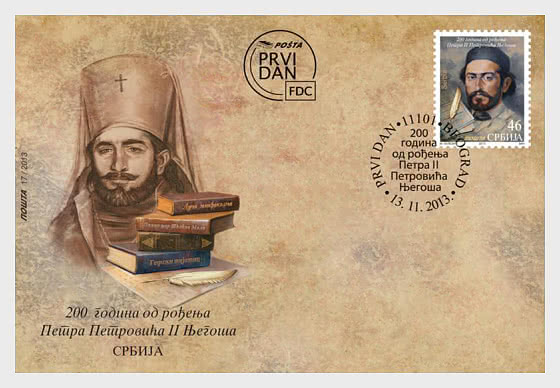
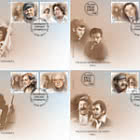
Petar II Petrović Njegoš (13. November 1813, Njeguši - 31. October 1851, Cetinje) was one of the greatest Serbian poets, the Prince-Bishop and ruler of Montenegro. He was born as the second son of Ivana Proroković and Toma Markov Petrović, the youngest brother of the bishop Petar I. He was also popularly known as bishop Rade, by his baptismal name Radivoje. He was educated in the Monastery of Cetinje, and in the Monastery of Topla, near Herceg Novi, he studied Italian language, mathematics, ecclesiastical singing, psalter and other subjects. Bishop Petar I declared him as his successor on 20. January 1827. After the death of his uncle, in 1831, Njegoš became monk and began to administer the state of Montenegro. In 1833, in Petrograd, he became bishop.
Njegoš was at the same time religious and secular leader of the Serbian people in Montenegro, where ruled a strong national consciousness and patriarchal morality, but also anarchy, tribal rivalry and vendetta. After coming to power, he began to impose order and modernize the society and state. He built schools and roads, founded courts of justice, and introduced taxation. It was really hard in such backward areas. He wrote „I am the ruler among barbarians, and I am barbarian among rulers“. In the spring of 1850. the bishop got ill of lung disease which he tried in vain to cure in Italy, and of which he died on 10. October 1851, in Cetinje. The Prince Danilo fulfilled in 1855. the legacy of Njegoš and conveyed his remains to Lovćen. The Lovćen chapel where he is buried was damaged by the storms and lightnings, but in 1879. Prince Nikola fortified the chapel and secured it with lightning rods. In 1916, when Austria conquered Montenegro, during First World War, his remains were conveyed to the Monastery of Cetinje.
On 23. September 1925, King Alexander Karađorđević conveyed his remains from Cetinje to the restored chapel, and in the seventies of the last century, at the spot of the old chapel at Lovćen was erected a mausoleum, created by the sculptor Ivan Meštrović.
Already as a boy, Njegoš began his poetic work, by imitating folk poetry, which he later on collected and published in the corpus „Serbian Mirror“. Vuk Karadžić considered that many of these poems dedicated to the recent Montenegrin battles were created by Njegoš himself.Later poetry was created under the strong influence of ancient classicism, which reflected indirectly and more formally. Among poems of Njegoš, in which prevails deep and thoughtful lyricism, we can distinguish the following: Montenegrin to almighty God, Faithful son of the night singing laudation to the thoughts and Ode to the Sun, and his most important works are: Microcosm Ray, Mountain Wreath and False Emperor Šćepan the Little.