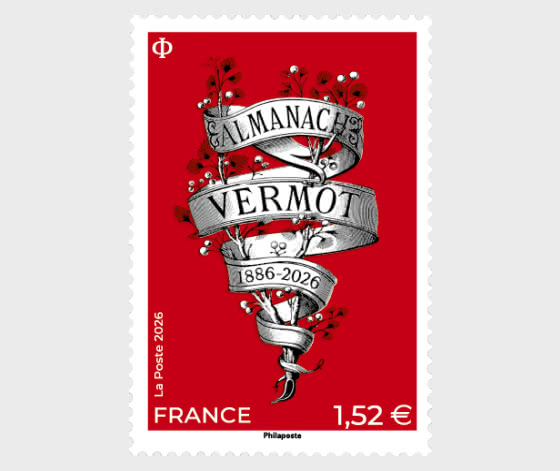
On January 5, 2026, the French postal service, La Poste, will issue a stamp commemorating the famous Almanach Vermot's 140th anniversary!
The Almanach Vermot, a testament to the evolution of attitudes and popular culture, is an institution. Specialists in popular literature have studied it with the utmost seriousness.
Created in 1886 by Joseph Vermot, it draws inspiration from rural almanacs that emerged after the Napoleonic Wars, such as Le Grand Messager boiteux de Strasbourg. But the origins of the genre date back to the 16th century: from towns to the countryside, a chapbook literature flourished thanks to the growth of trade routes. The catalog of the "Bibliothèque bleue" (Blue Library) of Troyes is a notable example; "blue" referring to the color of its covers. It contains everything from poetry, fables and tales, and short novels to ephemerides and practical guides.
The Vermot Almanac is recognizable by its red color and its logo, a scroll swirling like a cornucopia. This 384-page volume accompanies readers every day of the year, teeming with anecdotes, tips and tricks for everyday life, proverbs... and above all, jokes.
This blend of useful knowledge and lightheartedness is what makes the Vermot Almanac so successful. After Joseph's death in 1893, his son Maurice took over its publication and considerably expanded its distribution. A testament to its enduring popularity, under the direction of Georges Ventillard, the Almanac reached a print run of one million copies per year. Only the Second World War interrupted its publication. Since then, it has been published annually – today by Hachette. Vermot also passed on another legacy: that of caricature, satirical imagery, and press illustration. In the second half of the 19th century, the illustrated press experienced explosive growth thanks to technological advancements. The layout of newspapers changed, favoring columns of text into which images were inserted. The Almanac's visual identity adapted accordingly.
From its earliest editions, talented cartoonists contributed, as well as leading figures in 20th-century French caricature—special mention goes to Claude Turier and Jacques Faure, successive editors-in-chief until 2014. Today, others perpetuate the Vermot style, a blend of social satire and critical observation. The Almanac adapts to changing sensibilities, revealing accepted and contested forms of humor, and echoes the major causes that drive French society.