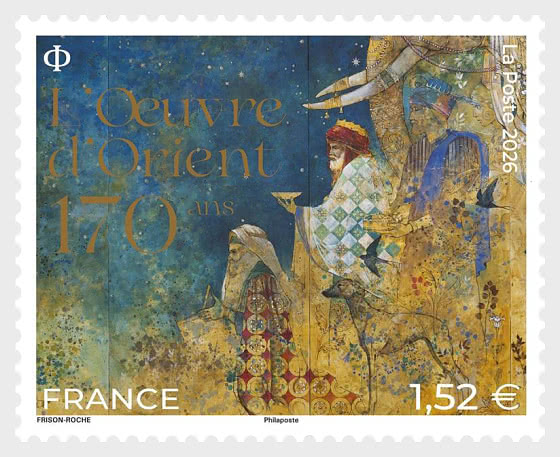
On April 13, 2026, La Poste (the French postal service) issued a stamp commemorating L’Œuvre d’Orient (The Work of the East) to celebrate the association’s 170 years of commitment to Christians in the Middle East.
L’Œuvre d’Orient was founded in 1856 during a pivotal historical period: the end of the Crimean War and the signing of the Treaty of Paris, which recognized France’s role in protecting Christians in the Ottoman Empire. Then called the Œuvre des écoles d’Orient (Work of the Schools of the East), it was created at the initiative of lay professors at the Sorbonne, gathered around Baron Cauchy, a renowned mathematician, to support the establishment of schools in Lebanon, convinced that education is essential for the future of any society.
In 1860, following the massacres of Christians by the Druze, Father Charles Lavigerie, its first director, recommended expanding its scope of action. This marked the beginning of a great history of solidarity.
Thus, as early as 1895, Bishop Félix Charmetant, the director, was one of the most active figures in France in denouncing the massacres and crimes suffered by Armenians and raising funds to help them.
Since then, L’Œuvre has continuously supported Christians in the Middle East through the most dramatic moments of their history: natural disasters, wars, famines, displacements… In 2026, L’Œuvre d’Orient, a French apolitical association, will celebrate its 170th anniversary. Present in 23 countries, from the Middle East to Eastern Europe, from the Horn of Africa to southern India, it supports Christian communities working on the ground, every day, for all through education, healthcare, social and humanitarian aid, culture, and heritage.
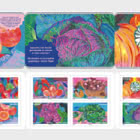
Because Epiphany is synonymous with Christmas for Eastern Christians, L’Œuvre d’Orient has placed its anniversary under the sign of The Celebration of Epiphany or the Adoration of the Magi, a painting by Augustin Frison-Roche, a symbol of Eastern spiritual richness and the universality of the message it has carried since its foundation.