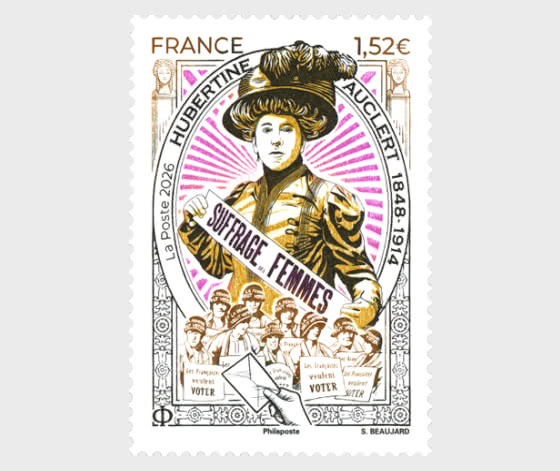
Hubertine Auclert was a feminist activist, the first French suffragist.
In 1873, she left her native Bourbonnais region for Paris after reading a letter from Victor Hugo denouncing the injustice of women's condition: excluded from citizenship during the Revolution, deprived of their civil rights by the Napoleonic Code, exploited in the workplace, and despised. She distinguished herself by presenting the right to vote as the cornerstone of all other rights. In her newspaper, La Citoyenne, the organ of the Women's Suffrage Society, she used the word "feminist" to describe those who fought for gender equality. She denounced the incompleteness of a democracy that excluded women from national representation. "No duties without rights, no rights without duties," she proclaimed. Disregarding the sarcasm, she devised actions with strong symbolic significance to raise public awareness. Prevented from registering to vote, she refused to pay her taxes: “I don’t vote, I don’t pay.”
After a stay in Algeria, where her husband had been appointed justice of the peace, she returned to France, wrote a weekly column for Le Radical, and rebuilt her group. She circulated petitions, engaged in propaganda, distributed feminist stamps, and called for the feminization of the language. Growing ever bolder, she organized the burning of the Civil Code during its centenary celebrations; stormed into a polling station to overturn “the ballot box of lies,” earning her the nickname “French suffragette”; and ran in the 1910 legislative elections.