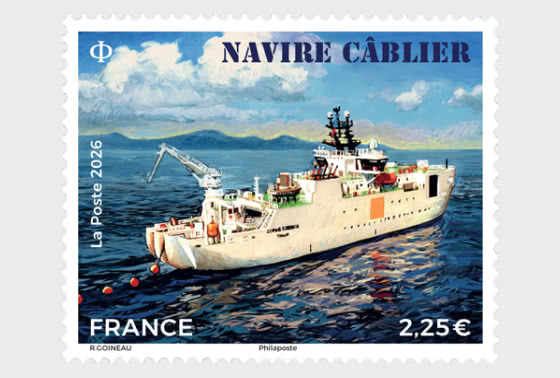
On April 13, 2026, La Poste (the French postal service) issued a stamp featuring the cable-laying ship that connects continents and has shaped today's connected world for over a century, combining maritime adventure and technological prowess.
More than 99% of global internet traffic travels along the seabed and ocean floor via submarine fiber optic telecommunications cables, some of which are thousands of kilometers long. At the end of 2025, the TeleGeography website counted 570 in service and 81 planned. These cables are the successors to the old telegraph and telephone lines laid on the ocean floor after the invention of Morse code in 1837. In 1851, the first cable link connected France (Calais) to England (Dover). In 1858, the United States and Europe were linked for the first time. For the colonial and maritime powers of the time, submarine telecommunications cables became a strategic infrastructure.
France established the first submarine electro-semaphore cable service in Toulon in 1863. It was equipped with a ship purchased from England: the Dix-Décembre, a steamship converted into a cable-laying vessel, renamed Ampère (the first of that name) in 1870. It remained in service until 1925. After it, twenty-five other French cable-laying ships were built, thirteen of which are still in operation. Six are operated by Orange Marine, the telecoms operator's subsidiary, and seven by Louis-Dreyfus Armateurs on behalf of Alcatel Submarine Networks (ASN), a fiber optic cable manufacturer nationalized by the French state in 2024. Created with expansion and sovereignty in mind—cable-laying ships fly their own blue, white, and red flag adorned with three lightning bolts, a star, and a gold anchor—the French fleet is now crucial to the smooth operation of the global internet network. It represents approximately one-third of the total number of cable-laying ships in the world, enabling it to intervene in virtually any sea to repair a damaged or severed cable within a few days.