2026Cesar-Pierre Richelet 1626-1698 - Set
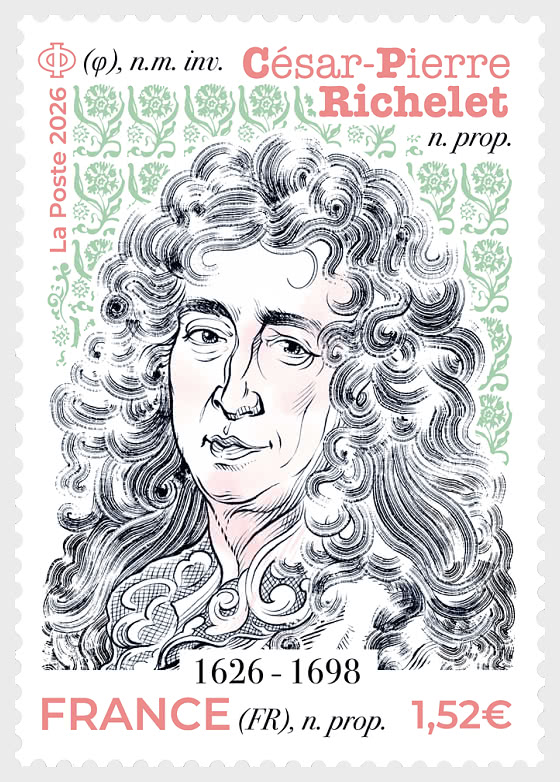
- 09.11.2026
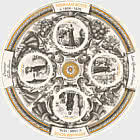
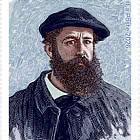
On November 9, 2026, La Poste will issue a stamp featuring César-Pierre Richelet a foundational figure in modern lexicography to mark the 400th anniversary of his birth.
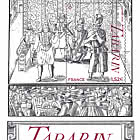
Aside from lexicographers, who knows of César-Pierre Richelet today? Yet, Richelet is nothing less than the inventor of the modern dictionary in France! He is, in fact, the author of the first monolingual dictionary of the French language: the *Dictionnaire françois*, published in Geneva in 1680.
Why Geneva? Because the *Académie française* established in 1635 by Richelieu was still working on its own dictionary forty years later, and it held the exclusive royal privilege to publish such a work within France.
However, weary of the *Académie’s* sluggish progress, certain academicians conceived a plan to beat the institution to the punch by compiling a rival dictionary a truly audacious undertaking! They needed someone capable of carrying the project through to completion. That man was Pierre Richelet.
Why him, and who was he?
Richelet was born in 1626 in Cheminon. After working as a school teacher, a private tutor, and later a lawyer, he soon abandoned the legal profession to dedicate himself to literature and the study of languages. A translator, a poet known for both gallant and satirical verse and an expert in versification, he eventually became a known figure within academic circles. This was due not only to his linguistic expertise but also (and perhaps primarily?) to his formidable character. Richelet was a man of conviction independent-minded and often sharp-tongued. His outspoken nature and satirical wit earned him many enemies, but also a reputation as a free spirit, possessed of great intellectual independence. The *Dictionnaire françois* reflects its author’s personality he describes himself as "a kind of adventurer." Yet, he was a learned adventurer: the work’s originality stems from its rich vocabulary, clear definitions, occasional eccentric or impertinent examples (which he used to settle personal scores), and citations from great authors.
The *Dictionnaire françois* was an immediate success and was reprinted many times throughout the 18th century.
It remains a pleasure to read today, as it bears witness to the free-thinking spirit of the "gentleman" (*honnête homme*) of the late 17th century.
Richelet died in Paris on November 23, 1698, at the age of 72. Through his exacting standards, his independent spirit, and his close attention to the French language as it was actually spoken, he stands as a foundational figure in modern lexicography.
France - Recommended stamp issues


WOPA+ recommended stamp issues

| Avatar - Fire and Ash |
| Issued: 03.12.2025 |
| ›New Zealand |
| 50th Anniversary of the Founding of the 24th November Bar Scout |
| Issued: 24.11.2025 |
| ›Montenegro |
| Krisjanis Valdemars |
| Issued: 02.12.2025 |
| ›Latvia |

| Sign Language - Good |
| Issued: 02.12.2025 |
| ›Bosnia and Herzegovina - Republic of Srpska |

| In Memory of the Fallen and Murdered on October 7, 2023 |
| Issued: 08.10.2025 |
| ›Israel |
| Annual Collection Folder (New York) |
| Issued: 05.12.2025 |
| ›United Nations |
| Year Set |
| Issued: 24.11.2025 |
| ›Isle of Man |
| Shipping in the 17th and 18th Centuries - Peat Shipping |
| Issued: 05.12.2025 |
| ›Netherlands |