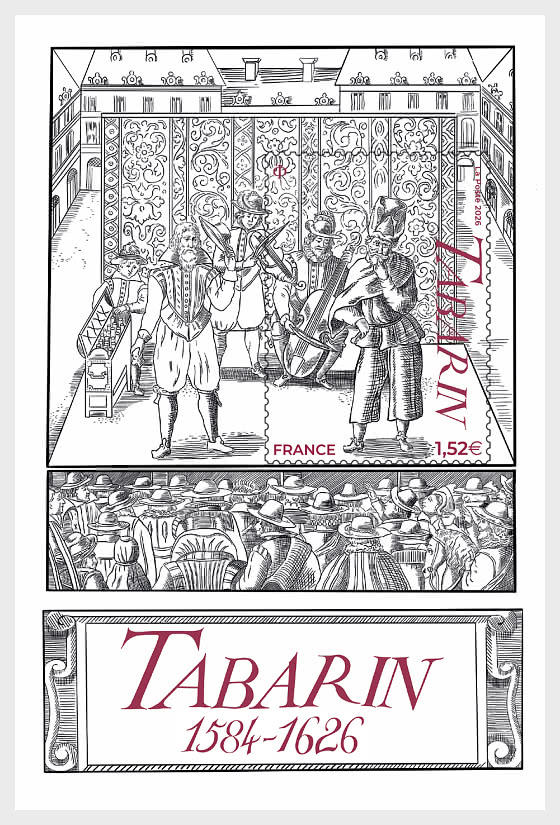
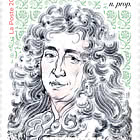
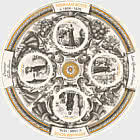
On November 9, 2026, La Poste will issue a souvenir sheet containing a single stamp to mark the centenary of the death of Tabarin—a figure associated with the popular theater and farces of the 17th century.
Born in Verdun around 1584, Antoine Girard traveled to Paris, where he met a group of acrobats from Milan. From them, he learned the art of comedy and subsequently toured France in their company. He adopted a theatrical alter ego: Tabarin, a mischievous valet whose name was derived from the *tabarro*—a type of Italian cloak. He completed the costume with a grotesque mask featuring a large mustache, along with a versatile, oversized hat that he could reshape into all manner of forms.
Around 1618, Antoine Girard joined forces with his brother Philippe, a doctor of medicine, to sell ointments and salves. They set up a makeshift stage near the Pont-Neuf, an area frequented by crowds mingling among artisans, charlatans, and street performers. To attract customers, the brothers would improvise comic dialogues in which Tabarin posed absurd questions to his master, the learned Monsieur de Mondor. These riddles—such as "Which came first: man or the beard?", "How can one make fifty pairs of shoes in half an hour?", or "What is the heaviest thing in the world?"—would leave the master perplexed, while his valet would provide answers that were absurd or satirical—often crude, yet full of spirit.
On certain evenings, they would also perform short farces inspired by the *commedia dell'arte*. On certain evenings, they also presented short farces inspired by *commedia dell'arte*: alongside Tabarin, his wife—the Roman dancer Vittoria Bianca—played the role of the cunning Francisquine, while her brother portrayed the braggart Rodomont. Their success was such that Parisians from all walks of life would crowd around their stage each day. The troupe was even invited to perform before the Queen Mother, Marie de' Medici.
In 1623, the Girard brothers left the stage and, using their earnings, purchased a manor house near Sens. After they had departed Paris, an anthology of their stage scripts was published without their knowledge, selling twenty thousand copies. Antoine Girard died on November 27, 1626—reportedly the victim of an ambush set by jealous neighbors. The memory of his antics would endure, exerting a notable influence on both La Fontaine and Molière.