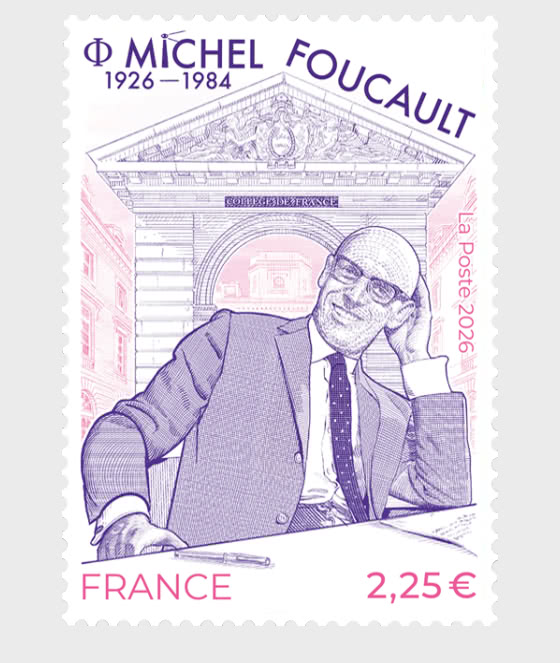
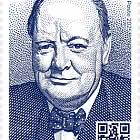
On October 19, 2026, La Poste is issuing a stamp featuring the philosopher and historian Michel Foucault to mark the centenary of his birth.
Michel Foucault is one of the most renowned French philosophers of the 20th century, distinguished both by the richness of his thought and his international influence.
Born in Poitiers on October 15, 1926, into a family of surgeons, he studied at the École Normale Supérieure on Rue d’Ulm (1946–1951). After passing the *agrégation* in philosophy, he became a professor of psychology and later philosophy, before holding the Chair of the History of Systems of Thought at the Collège de France from 1970 until his death in Paris on June 25, 1984.
Alongside his teaching career, he developed a prolific and innovative body of work addressing subjects such as madness, the birth of the human sciences, the emergence of the prison system, the use of pleasures, and the government of the self, as well as literary and aesthetic analyses (Manet, Raymond Roussel). He published numerous works, including *Folie et Déraison: Histoire de la folie à l’âge classique* (1961), *Les Mots et les Choses* (1966), *L’Archéologie du savoir* (1969), *Surveiller et punir: Naissance de la prison* (1975), and *Histoire de la sexualité* (1976–1984). Through the themes addressed, the author engages in a meticulous historical analysis aimed at explaining the succession of ruptures that transform social discourses and practices, never losing sight of this fundamental question: "What is philosophy I mean philosophical activity if not the critical work of thought upon itself? And if it does not consist, rather than legitimizing what is already known, in undertaking to discover how and to what extent it might be possible to think differently?"
Michel Foucault is also that "specific intellectual" engaged with his times who gives voice to prisoners, supports Tunisian students, and campaigns for the cause of the "boat people" and Solidarność.
His fertile body of thought widely disseminated across the globe through both translations and the lectures he delivered in the Americas, Japan, and North Africa continues to inspire a great deal of research today.