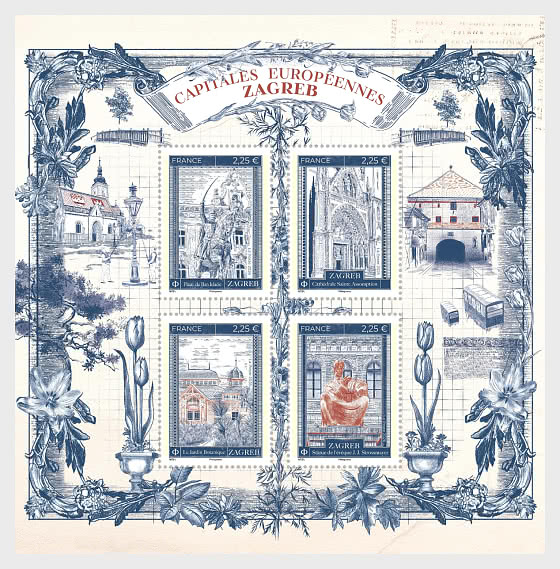
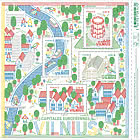
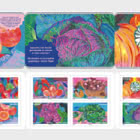
On October 12, 2026, La Poste invites you to continue the journey through European capitals with a sheet of four stamps dedicated to Zagreb. This series began in 2002 with Rome.
Zagreb’s history is shaped by a convergence of diverse influences. Situated between continental Europe and the Mediterranean, and between the Republic of Venice and the Habsburg Empire, the city once a bulwark against northern invaders and the Ottoman advance from the east eventually shed its fortifications. Following the revolutionary upheavals of 1848, it embraced a modernity befitting its future role as the Croatian capital, a transformation symbolized by the equestrian statue of Ban Jelačić.
Zagreb is a city of dualities, distinguishing between secular and religious authority. Two distinct urban entities sit on the slopes of Medvednica (Bear Mountain): Gradec, home to the Parliament (*Sabor*) and St. Mark’s Church where governors (*bans*) took their oaths of office and the ecclesiastical district of Kaptol, defined by its cathedral. Although a bridge known as the "Bloody Bridge" (*Krvavi most*) once spanned the gap between them, both the conflicts and the stream itself eventually gave way to a more peaceful atmosphere, embodied today by the succession of cafés along Tkalčićeva Street. A funicular now connects this historic Upper Town to the Lower Town, which expanded according to a horseshoe-shaped urban plan that alternates public parks with scientific, artistic, and social institutions.
Above all, Zagreb embodies a network of connections links that bind Croatian culture to European history and, more broadly, to a cosmopolitan heritage. Once situated along the route of the Orient Express, it is now traversed by the lights of festivals celebrating naive art or animated film as well as by universal emotions, such as the anonymous traces of romantic breakups collected since 2006 in the Museum of Broken Relationships, where a failed relationship becomes a human sentiment worthy of remembrance.