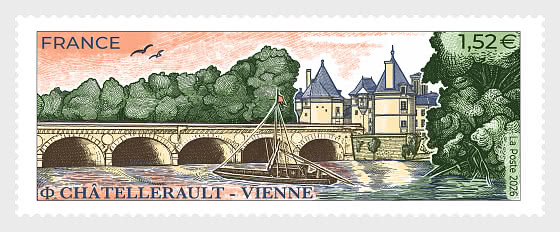
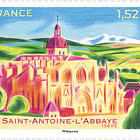
On September 7, 2026, the French postal service, La Poste, issued a stamp in its tourist series featuring Châtellerault in the Vienne department.
Spanning the Vienne River, the Henri-IV Bridge connects Châtellerault to its western suburb, Châteauneuf, succeeding earlier stone and then wooden bridges dating back to the 11th century, many of which had suffered considerable damage from conflicts and violent floods. In 1564, King Charles IX commissioned a study for the construction of a sturdy bridge. It would take 44 years and three successive kings before its completion in 1609, overseen by Charles Androuet du Cerceau and his son René. It measures 144 meters long and 21 meters wide, designed to support dwellings, which were never built. Resting on nine basket-handle arches adorned with cow horn finials, its eight piers are four meters thick.
Originally, the structure was fortified. On the town side, two square towers stood guard; they were demolished in the 20th century because they obstructed traffic. On the suburb side, the towers, which still exist, are round, 24 meters high, with a semi-circular moat. Demolished in 1824, a central pavilion with a monumental gate and drawbridge connected these two towers. They played a role in controlling and collecting pontooning fees at the town's entrance. Over time, they have also served as a prison, fire station housing, and an archaeological museum. The bridge was listed as a historical monument in 1913. Threatened with destruction by 12 tons of dynamite planted by the retreating German army, the structure was saved thanks to the efforts of Sub-Prefect Pierre-Marcel Wiltzer and Police Commissioner Charles Bichat, through negotiations conducted on August 31 and September 1, 1944. Long the only crossing point from one bank to the other and an architectural emblem of the city, of which it is the most famous monument, this bridge has withstood the ravages of time. Recent restoration work, carried out by the Vienne Department, allows it to face the 21st century with confidence.