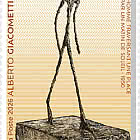
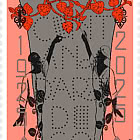
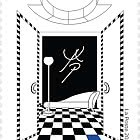
On January 12, 2026, the French postal service, La Poste, issued a stamp in its art series featuring an iconic work by Alberto Giacometti, "Man Crossing a Square on a Sunny Morning - 1950," to commemorate the 60th anniversary of his death.
The stamp's borders are illustrated with works by Alberto Giacometti, such as the "Head" lamp (circa 1933-1934), "Large Woman I" (1960), and "The Couple" (1926).
Elongated silhouettes, bodies, but also busts and faces in infinite space—a space that is both mental and physical, a space that can be defined by lines but is primarily inhabited by these figures. The figures are initially presented to the eye as refined, almost minimalist, reduced to a single line, a drawing. These works absorb their surroundings, so captivating is the material, marked by gesture, where time seems to condense and stand still, as if the gaze had penetrated the very essence of pure appearance. Alberto Giacometti's sculptures are instantly recognizable, found in the collections of the world's greatest museums. They radiate a sense of both presence and absence, inviting silence and contemplation of the body, its proportions, the face, of course, movement, and stillness. They crown a long and diverse career encompassing painting, drawing, sculpture, and printmaking.
Giacometti's career was influenced by his father's art in his native Switzerland, and later by his move to Paris in 1922, where he studied in Antoine Bourdelle's studio. He discovered the modern avant-garde, African art, and ancient Egypt, while also forging connections with artists such as Henri Laurens and Ossip Zadkine. The Surrealism of André Breton, whose group he joined from 1931 to 1935, also influenced his conception of the object. But even then, he was interested in the representation of the figure, of the gaze, one of the major themes of his work. This is already evident in his sculptures, whose size shrinks before increasing again, because everything is a matter of perspective. It is also evident in his post-war portraits of friends and confidants, from Michel Leiris to Jean Genet and Isaku Yanaihara, the Japanese philosopher, poet, and translator of Sartre, who himself devoted several essays to him. When he died in 1966, he had established a style that set him apart from his contemporaries, who were embarking on the beginnings of Pop Art, Minimalism, and Conceptual Art. He remains an absolute master of the 20th century.