Experience Nature - Birds Saba
| Sheetlets |
| First Day Cover |
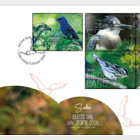
| First Day Cover |
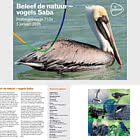
| Presentation Pack |
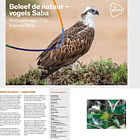
| Presentation Pack |
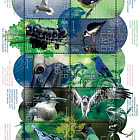
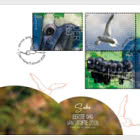
On 5 January 2026, PostNL will issue Experience nature – birds of Saba, a sheet of 10 stamps in 10 different designs. Each stamp bears denomination 1 for items up to 20 grams with a destination within the Netherlands. The price for a sheet of 10 stamps is €14.00. This stamp sheet featuring the birds of Saba is part of the multi-year Experience nature series dedicated to the Caribbean Netherlands from 2024 to 2026. Each year, four stamp sheets are released, each with 10 different stamps depicting plants and animals found in this part of the Kingdom. These islands boast an extraordinary biodiversity by Dutch standards, with thousands of plant and animal species. In 2026, the focus will successively be on birds, butterflies, underwater life and flora of the windward island of Saba. The first issue is the stamp sheet Experience nature – birds of Saba, showcasing the following birds: red-billed tropicbird, bananaquit, smooth-billed ani, black-necked stilt, brown pelican, blue grosbeak, belted kingfisher, osprey, black-and-white warbler and Antillean crested hummingbird.
SABA
The island of Saba, like Bonaire and Sint Eustatius, has a special status within the Netherlands. Collectively, these three islands are known as the Caribbean Netherlands. Together with Aruba, Curaçao and Sint Maarten, they form the Caribbean part of the Kingdom of the Netherlands. Saba belongs to the windward islands, a term referring to their position relative to the prevailing north-easterly trade winds. Saba lies 30 kilometres northwest of Sint Eustatius and 45 kilometres southwest of Sint Maarten. Roughly circular, the island measures about 4.5 kilometres across and covers an area of 13 square kilometres. Geologically, Saba is a dormant volcano with four lava domes. Its slopes descend steeply to the sea, and its coastline is rocky. At 870 metres, Mount Scenery is the highest point in the Netherlands. The climate is humid tropical, and the island is covered with secondary rainforest.
North of Saba lies Green Island, a small uninhabited rocky islet that also belongs to the island territory. To the south lies the Saba Bank, an underwater coral island. The Saba Bank is part of the Saba National Marine Park, a marine reserve of 1,300 hectares surrounding the entire coastline. Saba also has a national land park of about 43 hectares. The island’s steep rocky coast, partly within this park, is an important nesting area for the red-billed tropicbird, one of the 107 bird species recorded on the island according to a 2019 study by the Dutch Caribbean Nature Alliance (DCNA). Of these, 31 species were officially documented for the first time in that report.
DESIGN
The stamp sheet Experience nature – birds of Saba was designed by graphic designer Frank Janse from Gouda. Each bird is portrayed in its natural habitat on its own stamp. The featured birds are: red-billed tropicbird, bananaquit, smooth-billed ani, black-necked stilt, brown pelican, blue grosbeak, belted kingfisher, osprey, black-and-white warbler and Antillean crested hummingbird. All bird photographs are integrated into a graphic layer of circular shapes, also visible on the sheet margin. Some images extend onto adjacent stamps and the sheet edge. The designer added graphic elements inspired by symbols from old topographic maps, representing landscape features, contour lines, vegetation, soil structures and waterways. The design also includes an extra transparent layer with monochrome images (in white and colour) of characteristic flora and fauna from the region. These semi-abstract images cross the perforations, linking the stamps to each other and to the sheet margin. Depicted are: smooth-billed ani (top centre), trumpet tree leaves (top left), osprey (centre), chick of a black-necked stilt (bottom left), black willow inflorescence (bottom centre) and black-and-white warbler (bottom right).
TYPOGRAPHY
The typography uses DIN 2014, a typeface designed by Vasily Biryukov from Bulgaria and released by Paratype in 2015. In the captions on the stamp sheet, designer Frank Janse creatively and humorously expresses his associations with the names, traits and appearances of the birds depicted.
DESIGNER
The Experience nature series has focused on the plants and animals of the Caribbean Netherlands since 2024. It began with Bonaire in 2024, followed by Sint Eustatius in 2025. This year, it is Saba’s turn. “This island, like Sint Eustatius, is a windward island. They are close to each other and very similar,” says graphic designer Frank Janse from Gouda. “Saba is more volcanic, which means more fertile soil. It is also mainly hilly and mountainous, with fewer plains than Sint Eustatius. In terms of birds, there is much overlap. That’s why we determined the distribution of bird species across both stamp sheets at the same time.”
Seagull
Janse speaks from experience, as a nature enthusiast particularly fond of birds. “It started at an early age, collecting bird stamps. At primary school, I wrote in an essay that I wanted to be a seagull: flying high above people, always enjoying a beautiful view and moving freely wherever you want. For my 10th birthday, I received a bird guide to help me spot birds better. Recently, I’ve returned to this hobby, thanks to apps with bird sounds that make it easy to identify calls or songs. Birdwatching has become more popular because of this.”
Freedom and innocence
Birds, with their often attractive appearance, make a pleasant subject for stamps. “They always do well, as research shows,” says Janse. “I think it’s mainly the freedom of birds that appeals to people. And their innocence, although birds can be ruthless – at least in our eyes. For a graphic designer, bird photos are rewarding images to work with. Birds are easily recognisable thanks to their iconic shapes, whether circling in the sky or perched on a branch. This recognisability can also be applied illustratively, as in Chris Lebeau’s pigeon stamps from the 1920s. In art, birds are often used for their symbolic value – think of the fierce eagle, the innocent robin, the sociable sparrow or the dove as a symbol of peace.”
Everything is interconnected
The design of Experience nature – birds of Saba follows the concept that has characterised this series since its launch in 2018. Janse: “Over time, we’ve made a few adjustments, including to the typography. But the circle pattern remains. We introduced it to create an organic design with round shapes as a counterbalance to the rigid perforations of the stamps. It also allows images to blend into each other, in foreground and background. This makes the sheet a cohesive whole, adds depth and illustrates that in nature everything is interconnected.”
Variety
When selecting bird species for the Experience nature – birds of Saba stamps, Janse aimed for maximum variety. “Large and small species, forest, water and coastal birds – and of course, with the osprey, a bird of prey. Based on this distribution, I looked for striking photos I could crop for more variation. So now you see birds shown in full, but also close-ups, such as the head of the brown pelican and the belted kingfisher. Their intense gaze naturally draws attention. Groups of birds usually don’t work well on stamps because of the small format. Still, I made an exception for the amusing photo of the smooth-billed anis. It looks like a cartoon scene, with them chatting on a twig. The photo’s colours help, with deep black against a light green background.”
Residents and visitors
All birds depicted occur on Saba – some as visitors, others as migratory or breeding birds. “The bananaquit, for example, is one of the most common breeding birds on Saba,” says Janse. “They’re also called yellow-bellies or Caribbean tits, though they’re a completely different species from ‘our’ blue tit. Next to the bananaquit is the red-billed tropicbird in flight, showing its distinctive extra tail feather. There’s a large colony of these birds on Saba, but it’s under pressure because rats and feral cats threaten their nests. The bottom right stamp shows one of the three hummingbird species found on the island: the Antillean crested hummingbird. I deliberately chose a photo where it’s not hovering but perched on a leaf, so we can see its characteristic crest clearly.”
Colours
Green and blue dominate the Saba bird stamp sheet – the colours of the island’s vegetation and the Caribbean Sea. “Yet there’s only one truly blue bird: the aptly named blue grosbeak, whose plumage resembles bishops’ ceremonial robes,” says Janse. “To balance the colour distribution, I used a lot of blue in the transparent images. The other images show various shades of green – light green for the coast and dark green for the tropical forests. The order of the birds on the sheet was partly intuitive, but also followed well-known composition rules – for example, placing birds with sky backgrounds at the top and darker colours at the bottom as a solid base. The transparent images are strategically positioned to link the stamps.”
Reflection
The transparent images Janse mentions depict animals and plants from the Caribbean. “They help reflect the shapes of the birds and circles,” he says. “The belly of the transparent black-and-white warbler at the bottom right fits perfectly into the curves on the sheet margin. Its feet rest on the edge, while its head directs the viewer’s gaze back to the stamps. I also use the transparents to draw attention to details. For example, the dark smooth-billed ani at the intersection of the top four stamps highlights the tail feather of the red-billed tropicbird on the top left. Where possible, I let the main subjects ‘communicate’ through the transparents. On the middle row, the transparent osprey and blue grosbeak eye each other, emphasised by the huge eye of the brown pelican. The circles in the water on the black-necked stilt stamp reappear in the transparent image of the young stilt at the bottom left. In the final design phase, I added map symbols and contour lines of the island wherever space allowed, mainly along the sheet edges.”
About the designer
Frank Janse (Vlissingen, 1967) graduated as a graphic designer from the Willem de Kooning Academy in Rotterdam in 2001. Janse specialises in corporate identities, branding, infographics and communication campaigns. Until 2019, he worked for various advertising and design agencies, including Room for ID’s, and independently as Frank Grafisch Ontwerp in Gouda. In 2019, he co-founded Leene Visuele Communicatie with Leene Communicatie, focusing on content and information design. Since late 2022, Janse has been design director at VormVijf in The Hague. VormVijf works for governments, businesses and organisations, with citizens as the main target group. The agency combines strategy, design and content with the ambition to innovate, surprise and create impact. Clients include ministries, Novex Rotterdam Port, the Netherlands Court of Audit, the House of Representatives, the National Delta Programme and the National Glass Museum. On behalf of PostNL, Janse previously designed various luxury stamp storage systems and frame stamps, including themed collections. He also created designs for the Experience nature series from 2018 to 2025. In recent years, Janse has designed several stamps featuring 24-carat gold, including Snoopy 75 years (2025), Regalia of the Kingdom of the Netherlands (2024) and Holland America Line 150 years, Girl with a Pearl Earring and Inauguration of Juliana 1948 (2023).
Netherlands - Recommended stamp issues


WOPA+ recommended stamp issues

| Avatar - Fire and Ash |
| Issued: 03.12.2025 |
| ›New Zealand |
| 50th Anniversary of the Founding of the 24th November Bar Scout |
| Issued: 24.11.2025 |
| ›Montenegro |
| Krisjanis Valdemars |
| Issued: 02.12.2025 |
| ›Latvia |

| Sign Language - Good |
| Issued: 02.12.2025 |
| ›Bosnia and Herzegovina - Republic of Srpska |

| In Memory of the Fallen and Murdered on October 7, 2023 |
| Issued: 08.10.2025 |
| ›Israel |
| Annual Collection Folder (New York) |
| Issued: 05.12.2025 |
| ›United Nations |
| Year Set |
| Issued: 24.11.2025 |
| ›Isle of Man |
| Shipping in the 17th and 18th Centuries - Peat Shipping |
| Issued: 05.12.2025 |
| ›Netherlands |