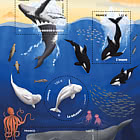
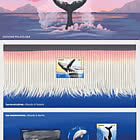
On March 16, 2026, La Poste (the French postal service) issued, in its Nature series, a block of four stamps and a philatelic souvenir dedicated to cetaceans. How could one not think of Moby Dick, the most mythical of whales?
Mythical and little-known: while cetology has progressed considerably since Aristotle, who observed that they had lungs and reproduced like mammals, cetaceans remain mysterious because, spending their entire lives at sea, they are mostly invisible at the surface and rarely seen near shore. Cetaceans comprise two suborders: Mysticetes, or baleen whales, and Odontoceti, or toothed whales. Among the latter, the Delphinidae family includes 37 species, from the orca to the small dolphins of the Southern Ocean.
The orca is found in almost all the world's seas; This large predator lives in matriarchal groups and feeds on a wide variety of prey, ranging from herring to whales. The sperm whale, Herman Melville's Moby Dick, is the largest of the toothed whales: males can reach up to 18 meters in length. They dive to depths of over 1,000 meters to capture their favorite prey, squid that can exceed 3 meters. They are remarkable for their social life, organized around groups of females, which are smaller than the males. Also highly social, belugas are opportunistic predators. Also called white whales, these 5-meter-long toothed whales live in Arctic seas, including near ice floes... hence their color! Belugas do not have a dorsal fin, unlike their cousins, the narwhals. The suborder Mysticeti comprises 15 species, the best known being the humpback whale. This whale, which feeds on small fish and crustaceans, breeds in the waters of tropical archipelagos, not far from the coasts where large crowds come to admire it. The humpback whale, also known as the megaptera due to its large pectoral fins, is also famous for its songs. Still sometimes hunted, cetaceans face the rapid industrialization of the marine environment. However, humpback whales, belugas, sperm whales, and orcas are not among the species directly threatened with extinction.