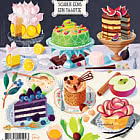
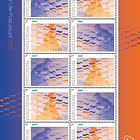
On 8 June 2026, PostNL is issuing the stamp sheet Write a cake, featuring 6 stamps in 6 different designs. The stamps show 6 different cheerful and tempting cakes. The title is a wordplay intended to encourage people to use these stamps especially for sending cards. The stamps carry denomination 1 for mail up to and including 20 grams with a destination within the Netherlands.
The Write a cake stamp sheet was designed by illustrator Jose Luis Garcia Lechner from Amsterdam. The price of a sheet of 6 stamps is €8.40. When rubbed, the stamps release the scent of sweet cakes.
SUBJECT
A cake is a usually round and often sweet baked product, mainly eaten during celebrations, as a dessert or as a treat with coffee or tea. The word ‘cake’ is derived from the French torte or tarte, which in turn is believed to come from the Latin torta(twisted pastry) or tortula (small white bread).
As early as 9,500 to 6,000 years ago, the ancient Egyptians made grain-based pastries from oats, wheat or rye, filled with honey and baked on glowing charcoal. Later, during the time of the pharaohs, bakers at the Egyptian court produced breads filled with fruit, nuts and honey. Their baking process is depicted in the tomb of Pharaoh Ramses II (circa 1300–1213 BC). According to some sources, the Israelites produced the first real pastries around the same time, including fig cakes. Alexander the Great (356–323 BC) is said to have introduced their baking skills to Greece. Cakes frequently appear in Greek plays. When the Romans conquered Greece, they too learned how to bake cakes.
With the Crusades and the voyages of discovery in the Middle Ages, cane sugar was introduced to Europe, making cakes increasingly sweet. The development of the closed oven and baking powder in the 19th century made it possible to bake lighter cakes.
Source: Wikipedia
DESIGN
Each of the 6 stamps on the Write a cake stamp sheet features a different colourful cake: a lemon meringue pie, a cassata cake, a fig and chocolate cake, a blackberry and berry tart, a mocha cake and an apple rose pastry. All cakes are incorporated into a larger illustration of a table that spans the entire stamp sheet. In this illustration, the upper cakes are placed on stands, while the lower ones rest on small plates. The stamps at the top show whole cakes; those at the bottom show smaller pastries and a slice of cake.
The self-adhesive stamps have a free shape that follows the contours of the cake and partly those of the tableware. Between the stamps, the sheet margin shows drawings of ingredients and tools used to make, present and eat cakes. Illustrator Jose Luis Garcia Lechner from Amsterdam created both the illustrations and the design of the Write a cake stamp sheet.
TYPOGRAPHY
The typography on the stamps uses BetonEF-Demibold from 1936 by German type designer Heinrich Jost (released by Bauersche Giesserei and digitally by Elsner+Flake). The title on the sheet margin is set in Haarlem Deco. This typeface from 2017 was designed by Indonesian type designer Fahrizal Tawakkal (released by Fontdation).
SCENTED STAMPS
When rubbed, the Write a cake stamps release the scent of sweet cakes. This is not the first time PostNL has issued scented stamps. Previous examples include Summer Stamps with a rose scent (2002), Douwe Egberts stamps with a coffee scent to mark the coffee producer’s 250th anniversary (2003), and Saint Nicholas stamps with a gingerbread scent (2013).
The fragrances are encapsulated in the ink at a microscopic level and are released by rubbing the stamp; scratching is not required. Other techniques involve incorporating scents into the paper or the adhesive layer. Scented stamps have also been issued by other countries, including Australia (freshly cut grass), Hong Kong (jasmine tea), Russia (fruit) and Switzerland (chocolate). More recent examples include issues by La Poste in France featuring the scents of baguettes and macarons.
DESIGNER
In 2022, the children’s book Smaakspoken was published, featuring texts by Daan Faber and illustrations by Jose Luis Garcia Lechner. The book received a Bronze Brush Award and includes a large illustration of a lemon meringue pie.
“Someone at PostNL had seen that illustration,” Garcia explains. “When they wanted to issue stamps about cakes, they thought of me. Of course I was delighted. One of my greatest hobbies is everything to do with food – from preparing and eating it to studying and drawing it. I love cooking for family and friends, with plenty of conviviality and tables full of food. That social aspect is a wonderful counterbalance to the solitary work of being an illustrator. I grew up in a large family with a Spanish father and a Dutch mother, where elaborate cooking was always part of daily life.”
Cakes from all corners of the world
For the Write a cake stamps, Garcia created illustrations of lavish cakes, each more colourful than the next. He also came up with the title as a wordplay to encourage people to use the stamps for sending cards.
“At first I wanted to draw typically Dutch cakes. But unlike many French, Italian and Spanish cakes, ours are mostly brown in colour. Very tasty, but not very colourful. That’s why I chose a different approach, with cakes from all corners of the world in all kinds of colours. They are inspired by existing cakes, but I gave them my own twist. The lemon meringue pie closely resembles the one in the children’s book. The green cake is a Sicilian cassata with marzipan, and next to it is a fig and chocolate cake. That last one isn’t entirely realistic, with far too many layers and far too many figs a pastry chef would never make it that way.
The upper stamps show larger cakes on stands, while the lower ones show smaller pastries and a slice of cake on dessert plates. One of my personal favourites is the familiar mocha cake. I always associate that with old fashioned Dutch cosiness.”
Searching for contrasts
PostNL asked Garcia to create cheerful and festive stamps. “That’s something I can do that atmosphere often appears in my illustrations. The festive aspect is emphasised by placing all the cakes on one large table. The upper part of the background is quite dark, which creates beautiful contrasts with the colours of the cakes. The tablecloth is suggested using lilac and cream-coloured stripes.
I enjoy searching for that kind of contrast in my illustrations, including in the cake stands. I drew several types: an old-fashioned glass stand, a playful porcelain one, and a wooden stand that could come straight from a Scandinavian design shop. Something similar happens at the bottom. The mocha cake sits on a plate with a floral pattern and a gold rim every care home seems to be full of them. Beneath the flowing apple rose pastry, I drew a more modern version: a sleek slate plate.”
Sketches
All sketches for the stamp illustrations were created in black and white on the computer. Garcia explains: “I work out those sketches in great detail so I can clearly see what I want to make. The better the sketch, the better the final result. Only when I – and of course the client am satisfied do I add the colours.
For the stamp drawings, very little changed in terms of content between the sketch concept and the final illustration. Only a piece of caramel lying on the table was removed. It added nothing and was simply distracting. I often fill my drawings with all kinds of elements to create a cosy atmosphere, but sometimes I go too far. Then I remove things again to restore the balance. That’s always a matter of intuition. Some elements I plan in advance, but more often I make decisions impulsively. For example, the order of the cakes on the stamp sheet is random. When I start an illustration, I have no idea how it will turn out and remain completely uncertain about the final result. But it always works out.”
Pure temptation
The table on the stamp sheet is filled with everything related to baking cakes. “This is pure temptation there’s no deeper meaning behind it,” says Garcia. “Everything on the table relates to making and eating cakes and the ingredients they contain. Naturally, everything is presented in the most visually appealing way possible: hazelnuts and pistachios, vanilla and cinnamon sticks, lemons, half an apple, a whisk with whipped cream, an egg yolk, a bar of chocolate, custard, ricotta cheese and a cake server, for example. And of course cake forks, including a golden one decorated with a sailing ship. Also included is the paper placemat under the apple rose pastry. I used the crochet pattern of that paper placemat as the background for the title at the top of the stamp sheet.”
Styles
Garcia uses different styles for his illustrations, depending on the subject. “That has to do with my training as a graphic designer. You learn to look carefully at how one style suits a particular assignment better than another. Of course, there is a common factor in my illustrations. They are often inspired by the time when photography was not yet widely used and magazines were still filled with illustrations. In particular, the atmosphere of the 1950s and 1960s frequently returns.
Not everything in my illustrations has to be correct – just look at the unsteady fig and chocolate cake. The perspective is not always accurate either, but that is deliberate. Some elements are literally pasted on, such as the twig with blueberries. That is how I prefer to work, with a certain clumsiness. I find that more appealing.”
About the designer
Jose Luis Garcia Lechner (Nijmegen, 1968) grew up in the Brabant town of Boxtel and studied graphic arts and graphic design at the Academy of Visual Arts St. Joost in Breda, where he graduated in 1993. He subsequently established himself as a freelance illustrator in Amsterdam under the name Studiogarcia. Garcia creates illustrations for, among others, newspapers, magazines, books, packaging, exhibitions, logos and visual identities. His clients include Albert Heijn, Algemeen Dagblad, de Bijenkorf, chef Yvette van Boven, Campina, food magazine Delicious, Elle, Elsevier, Het Financieele Dagblad, bicycle manufacturer Gazelle, brewery Grolsch, educational publisher Malmberg, Mr. Kitchen, publisher Snor, the National Maritime Museum Amsterdam and Stedelijk Museum Breda.