Experience Nature - Underwater Life Saba
| Sheetlets |

| First Day Cover |

| First Day Cover |

| Presentation Pack |

| Presentation Pack |
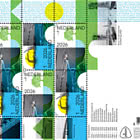
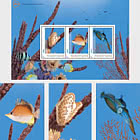
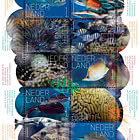
On 8 June 2026, PostNL is issuing Experience nature – underwater life Saba, a sheet of 10 stamps in 10 different designs. The stamps have denomination 1, intended for mail up to 20 grams within the Netherlands. The price for a sheet of 10 stamps is €14.00.
The stamp sheet about the underwater life of Saba forms part of the multi‑year Experience nature series, which from 2024–2026 focuses on Caribbean Netherlands. Each year, 4 stamp sheets are issued, each containing 10 different stamps. The stamps depict plants and animals found in this part of the Netherlands. The islands in this region boast an exceptional biodiversity by Dutch standards, with thousands of plant and animal species.
In 2026, attention is consecutively devoted to the birds, butterflies, underwater life and flora of the Windward Island of Saba. Earlier this year, PostNL already issued 2 stamp sheets about Saba: on 5 January about birds and on 30 March about butterflies. On the 3rd stamp sheet, Experience nature underwater life Saba, the spotlight is on the following species: great barracuda, flamingo tongue snail, long‑spined sea urchin, sergeant major fish, Caribbean spiny lobster, longsnout butterflyfish, Caribbean reef squid, brain coral, Nassau grouper and nurse shark.
SABA
Like Bonaire and Sint Eustatius, the island of Saba has a special status within the Netherlands. The collective name for these 3 islands is Caribbean Netherlands. Together with Aruba, Curaçao and Sint Maarten, they form the Caribbean part of the Kingdom of the Netherlands. Saba belongs to the Windward Islands, a designation referring to the islands’ position relative to the prevailing north‑easterly trade winds.
Saba lies 30 kilometres north‑west of Sint Eustatius and 45 kilometres south‑west of Sint Maarten. The roughly circular island measures about 4.5 kilometres across and has a surface area of 13 square kilometres. Geologically, Saba is a dormant volcano with 4 lava domes. The slopes descend steeply to the sea and the coastline is rocky. At 870 metres, Mount Scenery is the highest point in the Netherlands. The climate is humid tropical and the island is covered with secondary rainforest.
To the north of Saba lies Green Island, a small uninhabited rocky islet that also forms part of the island territory. To the south lies the Saba Bank, a submerged coral island. The Saba Bank is part of the Saba National Marine Park, a marine reserve of 1,300 hectares surrounding the entire coastline of the island, down to a depth of 60 metres. In 1987, the then government of the Netherlands Antilles designated the area as a national park. Since then, it has been managed by the Saba Conservation Foundation.
The Saba National Marine Park is popular with underwater tourists, who may only dive under supervision. In the zoning plan, the park is divided into different sectors for recreational and commercial purposes. A system of fixed mooring buoys facilitates diving and prevents damage to the coral. The Saba National Marine Park is one of the few self‑sufficient marine parks in the world, generating income from entrance fees, souvenir sales and donations.
Source: Saba Conservation Foundation, Wikipedia
UNDERWATER LIFE OF SABA
Thanks to strict restrictions, rules and regulations for fishermen, divers and other visitors, the Saba National Marine Park is a paradise for underwater life. Ecological research shows that more than 150 fish species occur in the park. These include the Nassau grouper, one of the species that has benefited most from the protective measures.
Species that prefer the open sea include the greater amberjack, great barracuda, king mackerel, tarpon and 5 shark species. Many schooling fish occur in the park, including wrasses and surgeonfish. Snappers, grunts, parrotfish, triggerfish and angelfish are also found in abundance. The park also provides a safe habitat for both the green turtle and the hawksbill turtle.
True coral reefs occur only in a few places in the park. Most coral structures grow on rocks of volcanic origin. The abundance of hard and soft coral species and sponges is often so great that the rocks themselves have become invisible. The seabed around the island is further characterised by pinnacles (needle‑like rocks) and lava tunnels.
In addition to resident species, the park is visited by many others, including hammerhead sharks, whale sharks, manta rays, spotted eagle rays, longsnout seahorses and, during the winter months, even whales.
Source: sabapark.org
DESIGN
The stamp sheet Experience nature underwater life Saba was designed by graphic designer Frank Janse from Gouda. All animals are portrayed in their natural habitat, each on its own stamp. The 10 species depicted are: great barracuda, flamingo tongue snail, long‑spined sea urchin, sergeant major fish, Caribbean spiny lobster, longsnout butterflyfish, Caribbean reef squid, brain coral, Nassau grouper and nurse shark.
All photographs are placed in a graphic layer featuring circular shapes, which are also visible along the sheet margin. In some cases, the image continues onto the adjacent stamp and the sheet margin. In various places, the designer added graphic elements derived from symbols used on old topographical maps, representing landscape forms, contour lines, vegetation, soil structures and waterways.
The design is further characterised by an additional transparent layer featuring monochrome images (both white and in colour) of characteristic fauna from the region. These images are almost abstract, run across the perforations and visually connect the stamps with each other and with the sheet margin. The animals shown in this way are: brain coral (top left), Nassau grouper (top right), sergeant major fish (centre), great barracuda (bottom left) and long‑spined sea urchin (bottom right).
TYPOGRAPHY
The typography uses DIN 2014, a typeface designed by Vasily Biryukov from Bulgaria and released by Paratype in 2015. In the captions on the stamp sheet, designer Frank Janse creatively and humorously expresses his associations with the names, characteristics and appearance of the depicted animals.
DESIGNER
Since 2024, the Experience nature stamp series has focused on the plants and animals of Caribbean Netherlands. The series began in 2024 with Bonaire, followed by Sint Eustatius in 2025. In 2026, it is Saba’s turn. Like Sint Eustatius, Saba is a Windward Island, and the two lie close together. When it comes to underwater nature, the islands are quite similar. Both are well‑known destinations for underwater tourism, partly because the waters around them have been designated as national marine parks: the Statia National Marine Park and the Saba National Marine Park.
Selection in advance
For the Experience nature series on Caribbean Netherlands, a selection of all animals and plants for the featured islands was already made in 2023. This research made grateful use of the Caribbean database of Naturalis in Leiden. Graphic designer Frank Janse explains:
“At the distribution stage, I first looked at whether we could create enough interesting combinations of animals and plants. Each issue then received a clearly different colour palette. That applies to all stamp sheets issued this year about the birds, butterflies, underwater life and flora of Saba. With underwater life, the big advantage is that you know the blue water will visually pull everything together. That makes things easier.”
Nature under water
“Nature under water is less easy to approach and observe than nature on land,” says Janse. “At first glance, you don’t see it, but there is just as much nature under water as above it. When you look at water, you see a flat surface with perhaps some waves. Below that lies an entire hidden world, including complete mountain ranges and deep ravines, where many still little‑known plants and animals may occur. As humans, we rarely go beyond the surf or the places where you can snorkel or dive. Even when snorkelling, however, the underwater world is fascinating to explore. You feel completely alone. But when you lift your head above the water again, you realise you are only a few metres from the shore, surrounded by other snorkellers.”
Distinctive colour palette
The photographs on the stamps depicting underwater life around Saba have a very distinctive colour palette. “That is also because sunlight changes as you go deeper under water,” Janse explains. “Red, orange, yellow and green gradually disappear because light waves of those colours are absorbed. Blue remains visible the longest, making everything at greater depths appear blue or blue‑green.”
The animals shown on the stamps all occur close to the coast of Saba, where the water is not very deep, generally no more than 20 metres. Some of the depicted species can, however, be found at greater depths, such as the flamingo tongue snail down to 90 metres and the Caribbean reef squid down to 150 metres, still within what is known as the sunlight zone, which extends to a depth of 200 metres.
Graphically interesting shapes
The stamps depicting the underwater life of Saba show only animals, not plants. “Even brain coral is an animal – more precisely, a colony of animals although you wouldn’t necessarily think so at first glance,” says Janse. “The flamingo tongue snail was high on my list after watching a documentary about nudibranchs. It stands out not only because of its shape and colour, but especially because of the pattern along its sides. Visually, it is very interesting, as if someone carefully applied it with a pen.”
Other animals on the sheet also have a strikingly graphic appearance, such as the sergeant major fish with its vertical stripes, which look almost painted on. The geometric folds of brain coral are also remarkable in shape. These colony‑forming stony corals form an almost perfect sphere, which fits beautifully with the circular design concept.
More and less water
On the first stamp in the top left corner of the sheet, the great barracuda swims, while on the last stamp in the bottom right corner, the nurse shark faces the viewer. Both are depicted centrally on their stamps, surrounded by water. “They look like animals you’d rather not encounter,” Janse notes. “But in practice, they are less threatening than they appear.”
For the other stamps, he deliberately chose images with less water for variation. The Caribbean reef squids and the longsnout butterflyfish are depicted at the same size as the barracuda and the shark, but that is misleading; in reality, they are much smaller. The sergeant major fish is a typical coral fish that lives in schools, which is why several are shown together on the same stamp. On the right, they swim into the sheet margin; on the left, they appear to disappear into the spines of the sea urchin on the adjacent stamp.
Variation in order
When determining the order of the photographs on the sheet, Janse aimed to introduce as much variation as possible, including in the swimming direction of the animals. “I always try to connect this to the circular patterns, for example with the spherical shape of the brain coral and the curve in which the longsnout butterflyfish swims. I also look for connections between the stamps through the placement of the images.”
Striking transparent images
The blue character of the stamp sheet is broken by transparent images along the edges and in the centre, featuring striking colours. “Normally, I only add the transparent images at a late stage,” says Janse, “but with underwater life, they were added much earlier. Their strong colours play an important role in preventing the blue from becoming too dominant. They are also more detailed than usual, providing a counterbalance to the often vague background of underwater photographs.”
Subtle adjustments
Thanks to the high quality of the photographs, it is rarely necessary to adjust the colours. “For this issue, I did make one exception,” Janse explains. “The photo of the sea urchin was lightened slightly to make it more recognisable. I always make a few subtle colour adjustments at the end, but they are confined to the edges of the stamps or the sheet margin. Sometimes I lighten colours slightly to improve the legibility of the sorting mark or captions, but these adjustments should never stand out.”
As a final step, the outline of the island of Saba was added to the stamp sheet. On the left and right, parts of the coastline are visible. “My starting point is always to follow the orientation of the map, with north at the top. In this case, the coastlines were slightly rotated to follow the coloured circular shapes as attractively as possible.”
About the designer
Frank Janse (Vlissingen, 1967) graduated as a graphic designer in 2001 from the Willem de Kooning Academy in Rotterdam. He specialises in corporate identities, branding, infographics and communication campaigns. Until 2019, he worked for various advertising and design agencies, including Room for ID’s, and as an independent designer under the name Frank Grafisch Ontwerp in Gouda. In 2019, he co‑founded Leene Visual Communication, focusing on content‑driven design and information design. Since the end of 2022, Janse has been design director at VormVijf in The Hague.
Netherlands - Recommended stamp issues



WOPA+ recommended stamp issues
| Avatar - Fire and Ash |
| Issued: 03.12.2025 |
| ›New Zealand |
| 50th Anniversary of the Founding of the 24th November Bar Scout |
| Issued: 24.11.2025 |
| ›Montenegro |
| Krisjanis Valdemars |
| Issued: 02.12.2025 |
| ›Latvia |

| Sign Language - Good |
| Issued: 02.12.2025 |
| ›Bosnia and Herzegovina - Republic of Srpska |

| In Memory of the Fallen and Murdered on October 7, 2023 |
| Issued: 08.10.2025 |
| ›Israel |
| Annual Collection Folder (New York) |
| Issued: 05.12.2025 |
| ›United Nations |
| Year Set |
| Issued: 24.11.2025 |
| ›Isle of Man |
| Shipping in the 17th and 18th Centuries - Peat Shipping |
| Issued: 05.12.2025 |
| ›Netherlands |