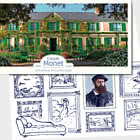
On November 9, 2026, La Poste will issue a stamp featuring Claude Monet to mark the centenary of his passing. One hundred years after his death on December 5, 1926, Monet is no longer viewed solely as the "master of Impressionism." Indeed, no one today would think to describe his final series, the *Water Lilies* (*Nymphéas*) on display at the Musée de l’Orangerie as the "Sistine Chapel of Impressionism," a term coined by André Masson in 1952. It is true that the group of painters who exhibited together in the studio of the photographer Nadar in 1874 adopted the label "Impressionist" a term originally used ironically by the critic Louis Leroy and derived from the title *Impression, Sunrise* (*Impression, soleil levant*; Paris, Musée Marmottan Monet Académie des Beaux-Arts) to designate a movement that never possessed a written doctrine or a closed circle of devoted followers.
Today, another side of Monet has come to the fore: the man who, in his garden at Giverny preserved to this day thanks to the Académie des Beaux-Arts, to which it was bequeathed created a form of "land art" long before the term existed, designing and planting his Japanese-inspired pond. It was also the man who, in his final studio lit from above and devoid of any actual landscape in his line of sight conceived those "grand decorations" that he gifted to France, through his friend Clemenceau, to mark the victory of 1918. Fighting with his brushes from an imaginary trench, Monet brought about a revolution that may well have been more significant for the 20th century than Impressionism itself: he fashioned a self-contained world of pure painting a space to move within, where the "viewer" is no longer merely standing before a framed, wall-hung canvas, but is instead immersed in the paint itself. It was an expansive, vibrant surface that, following the Second World War, would resonate with American Abstract Expressionists, from Pollock to Rothko. The centenary of Monet’s death also traces the evolution of how we have looked at the work of an artist who never ceased to reinvent himself.