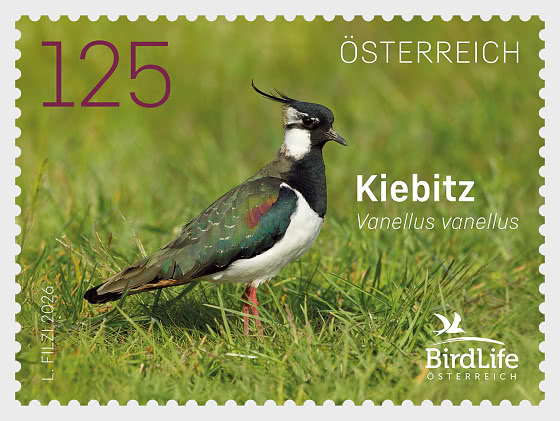
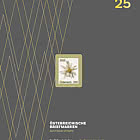
The northern lapwing, Austria’s bird of the year 2026, is the third design for the “Austrian birds” series, through which Austrian Post, in collaboration with BirdLife Österreich, is presenting endangered birds.
With its black-and-white and shimmering metallic-green feathers and its crest, the roughly dove-sized northern lapwing (Vanellus vanellus) is an eye-catching bird that is usually seen over agricultural land in open countryside. If you are lucky, you might have the opportunity to witness its spectacular “tumbling” flights over its territory between March and May.
The northern lapwing nests on the ground in farm fields, preferably with other lapwings, because all of the birds in a colony work together to fend off potential predators. However, this cannot protect them against the risks posed by agricultural work. Agricultural land has become their substitute habitat, replacing lost wetland meadows and sparsely planted undisturbed areas. Since 1998, the population of northern lapwings in Austria has halved. In BirdLife Österreich’s list, which uses a traffic-light-based system that categorises species according to their need for protection, the northern lapwing is listed in the highest category, red, and in Carinthia it will soon be extinct. In order to prevent that, the clutches of eggs laid on agricultural land have to be protected, and the young have to be provided with areas where they can find nourishment, such as fens, wet patches, field margins and fallow land near the breeding grounds. Wetlands in particular provide a place where the young birds are able to feed themselves independently shortly after hatching, and in the best case scenario, where they can care for their own young the following year.