2026Crafts - Calligrapher - Set
- 15.06.2026
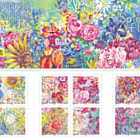
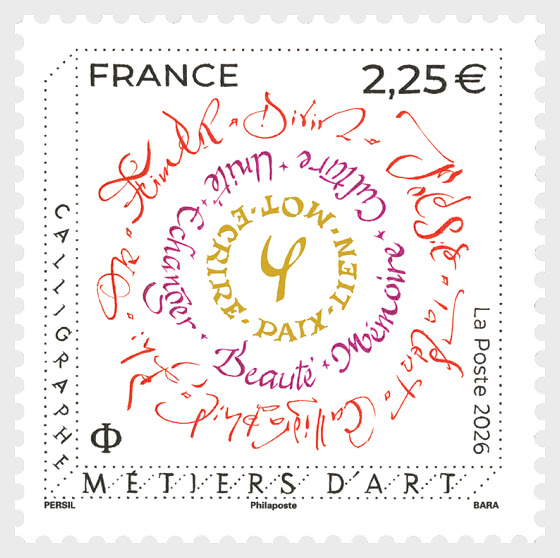
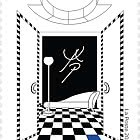
On June 15, 2026, La Poste (the French postal service) will issue a stamp in its Métiers d’Art (Crafts) series, launched in 2016, featuring the calligrapher's craft, following that of the watchmaker.
Calligraphy, a source of inspiration... from the Greek words calli, meaning "beautiful," and graphein, meaning "to draw." Since the dawn of time, humankind has felt the need for "the art of beautiful writing," intimately linked to its deities. Imprints, instinctive expressions of faith, even before writing, have accompanied humanity for approximately 6,000 years.
From Lascaux to hieroglyphs, from cuneiform writing to the Phoenician alphabet, and including the Roman capital with its perfect proportions an unsurpassed alphabet from which all other alphabets and countless discoveries would derive the evolution is remarkable.
In the time of the Egyptians, the scribe was a notable, a scholar whose god was Thoth. The calligrapher has also been central to monasteries for centuries, where he is known as "the Prince."
Knowledge, but also spirituality, is inscribed by the calligrapher's hand. The gesture must be perfect and definitive on the parchment.
Writing and calligraphy are inseparable, and yet one requires meaning, through alphabetic reading and legibility, while calligraphy is not only utilitarian, but also formal and artistic. We must learn to write before learning to calligraph.
Dexterity is essential.
Silence, slowness, solitude, and asceticism are the calligrapher's companions. Calligraphy is a meditation that touches upon alchemy and the sacred through thought and the word.
What is the meaning of the PHI symbol on each stamp?
“Divine proportion, Golden Ratio,” it is the symbol of Beauty, Perfection, Aesthetics, and Unity.
It is also a reference to Phidias, the 5th-century BC Greek sculptor, goldsmith, and painter, who established harmony between the real and the abstract. A foundational element for subsequent centuries.
So, what is the relationship between PHI and Calligraphy?
There is no randomness in calligraphic forms. Every proportion of a letter is exact, precise. Unique like its vibration. We find the Golden Ratio there. Today, total freedom of gesture, of mark, is offered to us like a musical improvisation.
This is how the tools vary, the word passing from legible to illegible.
The calligrapher's dexterity with any tool reveals their virtuosity.
The Body and Breath serve as a metronome for the calligrapher's creative inspiration. Then this "divine trace" through "the unique stroke" emerges, modestly revealing the calligrapher's inner self, making the invisible visible, like a dance.
France - Recommended stamp issues

WOPA+ recommended stamp issues

| Avatar - Fire and Ash |
| Issued: 03.12.2025 |
| ›New Zealand |
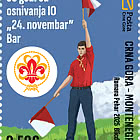
| 50th Anniversary of the Founding of the 24th November Bar Scout |
| Issued: 24.11.2025 |
| ›Montenegro |
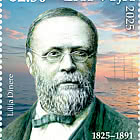
| Krisjanis Valdemars |
| Issued: 02.12.2025 |
| ›Latvia |
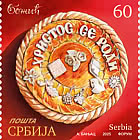

| Sign Language - Good |
| Issued: 02.12.2025 |
| ›Bosnia and Herzegovina - Republic of Srpska |

| In Memory of the Fallen and Murdered on October 7, 2023 |
| Issued: 08.10.2025 |
| ›Israel |
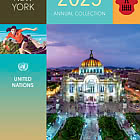
| Annual Collection Folder (New York) |
| Issued: 05.12.2025 |
| ›United Nations |
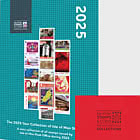
| Year Set |
| Issued: 24.11.2025 |
| ›Isle of Man |
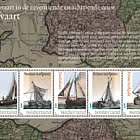
| Shipping in the 17th and 18th Centuries - Peat Shipping |
| Issued: 05.12.2025 |
| ›Netherlands |