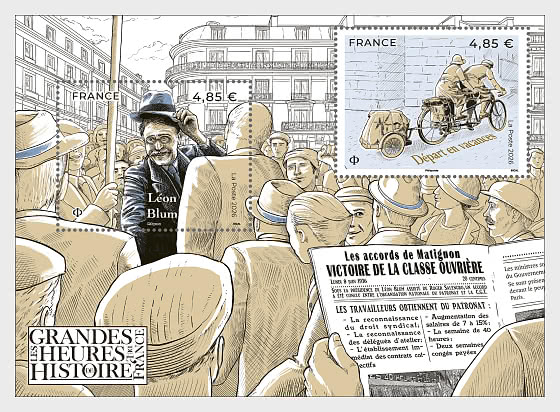
On May 3, 1936, the Popular Front coalition won the legislative elections. On June 6, for the first time, a socialist, Léon Blum, was appointed Prime Minister. A proponent of demand-side economic stimulus inspired by the American New Deal, Blum faced an unprecedented social movement that ultimately involved nearly three million strikers.
These strikes, with their occupation of workplaces, were a celebration: impromptu dances, card games, theater performances, and even a tour by Tino Rossi, who came to sing for the saleswomen at Galeries Lafayette. "Finally, we can breathe," wrote the philosopher Simone Weil. Employers panicked and believed the time for revolution had come. They implored Blum to organize a meeting with the CGT (General Confederation of Labour) to establish a new social contract. The discussions began at 3 p.m. on June 7 at the Hôtel de Matignon. The talks were tense but civil. Duchemin, president of the CGPF, the forerunner of the Medef, expressed his shame when presented with the figures for the lowest wages. At the time, there was no minimum wage.
At 12:40 a.m., the agreements were signed, marking an incredible social advance: collective bargaining agreements, the election of employee representatives, a ban on any sanctions for striking, and wage increases of 7 to 15%. The two other main demands, the 40-hour workweek and two weeks of paid vacation, were approved by the National Assembly on June 11 and 12. The strikes slowly subsided, and the labor movement returned to normal.
The Matignon Agreements then became a benchmark and a great myth for the left. For Léon Blum, they were meant to mark the beginning of a new era, one of ongoing dialogue between capital and labor instead of constant confrontation. This would not be entirely the case. “Despite everything,” he wrote, “I had brought a kind of brighter future to difficult lives.”