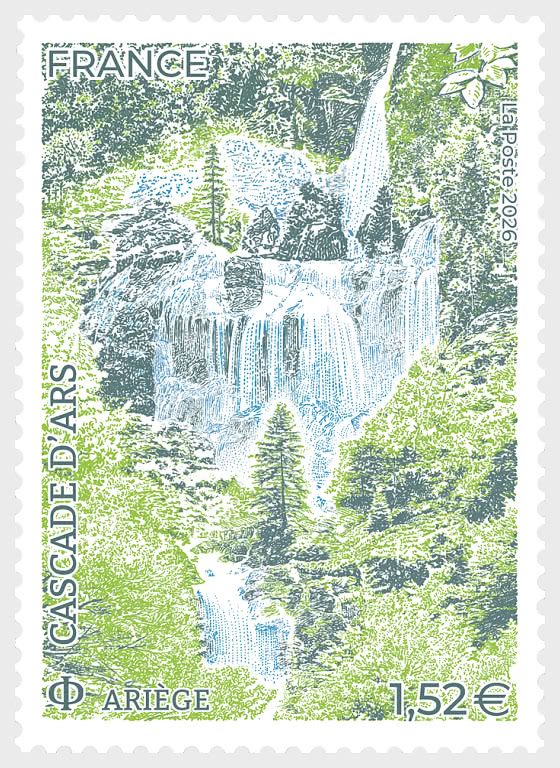
On June 8, 2026, the French postal service, La Poste, issued a stamp featuring the Ars waterfall, located in the Ariège Pyrenees Regional Natural Park in the Couserans region.
It cascades down the mountain in three successive tiers, dropping 246 meters. The Ars waterfall, named after the stream that feeds it, is one of the most impressive in the Pyrenees, even more so in late spring when its waters are swollen by snowmelt. This valley is a crossroads. During the Second World War, people fleeing the Occupation made their way through it. It is also a traditional route for herds heading to Spanish pastures. Here, pastoralism remains vibrant, as evidenced by the keen interest of visitors and locals in the transhumance that takes place in May and June. To reach the waterfall from the spa town of Aulus-les-Bains, you need to walk for a good hour and a half, first on a wide path and then on a steeper trail, sometimes carved into the rock, through beech trees. The falls can be seen from afar and are a striking feature of the landscape.
The Ars Valley, with its remarkable shape, was carved by glaciers. An iconic site in the Ariège region, the Ars waterfall and its valley have been listed as a protected landscape since 2018. It can be considered a link between the Cirque de Cagateille, with its hanging valleys (also a protected site), and the Étang de Lers, a geologically significant area. It was there, in fact, that lherzolite, a rare rock from the Earth's mantle, was discovered. These sites are all located within a protected area, the Pyrénées Ariégeoises Regional Natural Park, in the heart of the Couserans region and its 18 valleys. Mountains are everywhere. The most iconic remains Mont Valier and its 2,800 meters altitude. In these peaks, the ibex has made its return, reintroduced in 2014. It had been more than a century since it had disappeared from the French part of the Pyrenees.