2026Delta Works - The Netherlands and Water - Sheetlets
- 05.10.2026
- Hans Gremmen, Amsterdam
- Royal Joh. Enschedé BV, Haarlem
- Paper normal with phosphor coating Gumming gummed
- yellow, black, green, blue and metallic grey
- Stamp format (w x h) 36 x 25, Sheet format (w x h) 108 x 150 mm
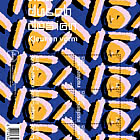
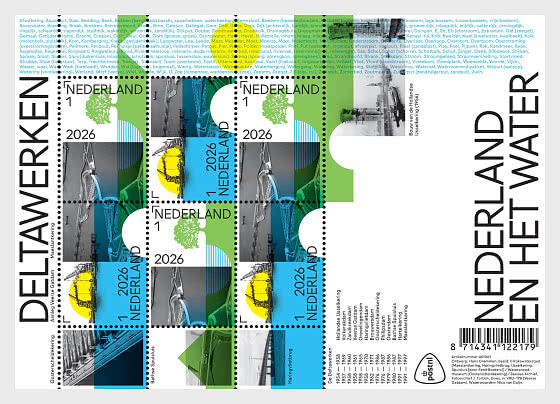
PostNL will issue the stamp sheet Delta Works – The Netherlands and water on 5 October 2026, featuring 3 sets of 2 different stamps. The stamp sheet with 6 stamps shows how the Netherlands has rigorously defended itself against flooding in the south-west of the country following the Flood Disaster of 1953, and more generally how the Dutch live with the delicate interplay between land and water, as 60% of the country is vulnerable to flooding and 26% even lies below sea level.
Delta Works
The Delta Works form a vast defensive system in the south-west of the Netherlands to protect the country from high water from the North Sea. Although the dangers had long been discussed, this system of thirteen major dams, storm surge barriers and locks was only constructed after the devastating Flood Disaster of 1953. Twenty days after the disaster, the Delta Commission was established under the direction of Rijkswaterstaat, and less than a year later work began on the first structure, the Hollandse IJssel storm surge barrier. The Maeslant barrier near Rotterdam was the final piece and was completed in 1997. With five storm surge barriers, two lock complexes and six dams, Zeeland, South Holland and North Brabant have largely been closed off from the sea, while the ports of Rotterdam and Antwerp have remained accessible. The largest and most challenging project was the construction of the Eastern Scheldt storm surge barrier. The Delta Works have been declared one of the seven modern wonders of the world.
The construction of the Delta Works proceeded as follows:
1954 − 1958 Hollandse IJssel barrier
1959 − 1960 Zandkreek dam
1956 − 1961 Veerse Gat dam
1958 − 1965 Grevelingen dam
1957 − 1969 Volkerak dam
1958 − 1971 Haringvliet dam
1962 − 1972 Brouwers dam
1969 − 1986 Eastern Scheldt barrier
1976 − 1987 Philips dam
1979 − 1987 Oester dam
1980 − 1987 Bath sluice
1991 − 1997 Hartel barrier
1991 − 1997 Maeslant barrier
DESIGN
Selection of photographs
The stamp sheet was designed by Hans Gremmen. ‘It was quite a puzzle, just selecting the photographs alone. There are many elements such as locks, dykes or bridges, and you want to show as much as possible. Moreover, the area in which the works are located is quite large; it is not just Zeeland. The first and the last, the Hollandse IJssel barrier and the Maeslant barrier, definitely had to be included, in my view, as well as the largest structure, the Eastern Scheldt barrier. That is the flagship of the Delta Works; I already went there as a child to see it. Furthermore, I opted for as much diversity as possible, both geographically and visually.’
Selection of illustrations
‘The drawings I used primarily show the interaction between land and water,’ says Gremmen. ‘As for the tree, I deliberately chose an oak, as it is a native tree and the most common tree in the Netherlands. The drawings of the cranes refer to the enormous construction effort required for the works. I incorporated the prominent sun on the horizon into the overall design because the sun is a symbol of hope. The sun rises again every day and thus represents a new beginning, and the Delta Works marked the start of a safer existence. The photographs are in black and white, and for the illustrations I used, alongside the yellow of the sun, the blue and green that are used in cartography to indicate water and land. Maximum clarity.’
Stamp sheet
‘It was great fun to design this stamp sheet. I wanted to convey the interaction and the forced relationship between water and land, and the tension involved in keeping one’s feet dry, but also the robustness of the Delta Plan and the sense of security and control provided by the Delta Works. I constantly had to zoom in and out, because the stamp sheet as a whole has to convey a certain feeling, while the individual stamps must stand strong on their own. It made sense to work with repetition using 3 sets of 2 different stamps, but by reversing the photograph and the illustration on each stamp, the overall design remains dynamic.’
Water words
‘In my search online, I came across a list of 254 Dutch words related to water, the states in which water exists, and the manageability of water. That is quite a large number, which shows how important water is to us. This list was compiled by Nico van Duijn. I felt it fitted perfectly and contacted him to ask whether I could place the list along the edge of the stamp sheet. Fortunately, he thought it was a great idea.’
Stamps
‘The Maeslant barrier lent itself well to the stamps, because this storm surge barrier consists of two enormous curved gates that usually stand open like doors. On the stamps they are shown in the closed position. This image can easily be split in two, with each part standing independently on a stamp, on the left or right. Due to the connected placement of the stamps on the sheet, the full image of the two parts of the barrier appears twice. The rounded shapes are also reflected in the white cut-outs and the suns.’
Stamp family
‘Stamps on the Delta Works and related subjects have been produced before. I do not deliberately quote those designs, but I do give them a nod. I think it is important that my design fits within the family of stamps on this subject.’
Typography
Gremmen used Jungka, a typeface designed by the South Korean Jungmyung Lee and the Dutch designer Karel Martens. ‘It is a very ordinary font, yet slightly more refined than Helvetica. The font conveys neutrality without being dull and has a distinctive expressive quality.’
About the designer
Hans Gremmen (Langenboom, 1976) studied at the Graphic Lyceum Eindhoven, followed by a course in graphic design at the Academy of Art and Design St. Joost in Breda and a master’s degree at the Werkplaats Typografie Arnhem, where he was taught by, among others, Karel Martens, who also designed several stamps. After graduating in 2003, he established himself as an independent designer in Amsterdam. Gremmen mainly works as a book designer in collaboration with architects, artists and photographers. His clients include the Nederlands Fotomuseum in Rotterdam, the Office for Contemporary Art in Oslo, Delft University of Technology, publisher Valiz in Amsterdam and the Zeeuws Museum in Middelburg. Together with Petra Stavast, Gremmen runs Fw:Books, an independent publishing house specialising in books on photography and related subjects. He previously designed the stamp sheet Intangible Cultural Heritage (2024).
Netherlands - Recommended stamp issues


WOPA+ recommended stamp issues

| Avatar - Fire and Ash |
| Issued: 03.12.2025 |
| ›New Zealand |
| 50th Anniversary of the Founding of the 24th November Bar Scout |
| Issued: 24.11.2025 |
| ›Montenegro |
| Krisjanis Valdemars |
| Issued: 02.12.2025 |
| ›Latvia |

| Sign Language - Good |
| Issued: 02.12.2025 |
| ›Bosnia and Herzegovina - Republic of Srpska |

| In Memory of the Fallen and Murdered on October 7, 2023 |
| Issued: 08.10.2025 |
| ›Israel |
| Annual Collection Folder (New York) |
| Issued: 05.12.2025 |
| ›United Nations |
| Year Set |
| Issued: 24.11.2025 |
| ›Isle of Man |
| Shipping in the 17th and 18th Centuries - Peat Shipping |
| Issued: 05.12.2025 |
| ›Netherlands |