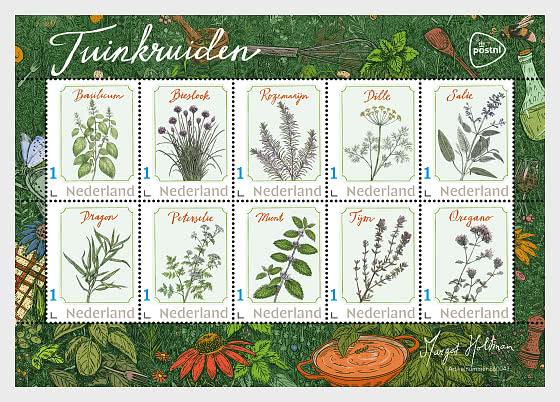
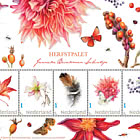
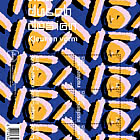
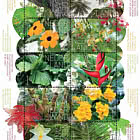
The stamps feature ten garden herbs: basil, chives, rosemary, mint, sage, tarragon, parsley, dill, thyme, and oregano. These are the ten garden herbs most frequently used in the kitchen in the Netherlands which is why they are also known as culinary herbs. All ten are depicted very realistically and stand alone, and each features the same background color. Surrounding them on the stamp sheet is a colorful, atmospheric fantasy garden with a wilder composition of grass, plants, flowers, insects, and various cooking utensils.
DESIGN
Stamp sheet
Designer Margot Holtman: ‘I initially envisioned a set table, viewed from above, with ten plates depicting the garden herbs. However, I felt that design lacked the garden element. Therefore, I drew a wild garden on the edges of the stamp sheet, which I filled in freely, not just with a bee, a butterfly, flowers, and other natural elements.’ Because garden herbs are used in the kitchen, I have added elements that are suitable for cooking, such as a whisk, a ladle, a fork, olive oil, and a pepper mill. Since the stamp sheet is released at the beginning of autumn, I have also included a pot of pumpkin soup. The style of the garden drawing contrasts strongly with the botanical drawings of the garden herbs.’
Stamps
‘To start with, I selected the ten herbs. I was a cook for many years alongside my work as an illustrator. The depicted herbs are the most used in the Netherlands, all year round. The eleventh in that series, coriander, was dropped. That is a pity, but there are ten stamps, after all. I drew them very precisely as you might find them in a vegetable garden and used a light green background against which they stand out beautifully.’
Illustrations
‘For a number of years now, I have been drawing a lot digitally on the iPad. This allows me to work in even greater detail because you can zoom out on the drawings there. It is still artisanal work; I therefore draw all those small strokes in the hatching patterns I often use myself, but with the various pens and brushes from the Procreate program.’
Typography
The title ‘Tuinkruiden’ and the designer’s name are written on the iPad and therefore display Margot Holtman’s handwriting.
About the designer
Margot Holtman (1984) creates detailed and refined drawings, which are often characterized by the extensive use of cross-hatching. Nature is her favorite subject. She obtained her bachelor’s degree from the Gerrit Rietveld Academy in Amsterdam and a minor in Illustration at the Pratt Institute in New York. Afterwards, she participated in various residencies, including on Madeira, in New York, and in Leipzig. Her work has been shown in various group exhibitions and magazines (Mystical Miles, Tummy Magazine). In addition, she worked as a cook until she achieved a breakthrough with her illustrations in the column ‘De aard van het beestje’ in de Volkskrant, for which Casper Janssen wrote the text. She received the 2024 Nature Book Prize for the eponymous book published based on those columns. Nowadays, she primarily illustrates children's books, such as the Das Droog series which she creates together with her sister Dagmar Holtman, but she is also working on a book for adults about poisonous animals and plants, for example. Previously, she designed the Tuininsecten stamp sheet (2024).