2026Ornamental Birds, Colourful and Elegant - Sheetlets
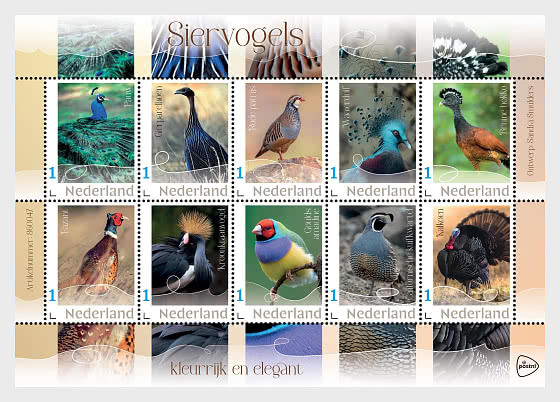
On 14 October 2026, PostNL will issue the Ornamental Birds, Colourful and Elegant stamp sheet, featuring 10 different stamps. The issue is released to mark Stamp Day, an annual international event.
Stamp Day
In most countries, Stamp Day is celebrated on the first Sunday after 9 October, the date on which the Universal Postal Union (UPU) was founded. The UPU, also known as the World Postal Union, establishes the rules governing international postal traffic between its member countries.
Renewal
Since 2009, PostNL has celebrated this day by issuing a stamp sheet featuring a design based on notable Dutch stamps from the past. In 2025, for example, a stamp sheet was issued featuring a contemporary interpretation of the Toorop stamps from 1923.
From this year onwards, PostNL has decided to stop using old stamps as the basis for its annual Stamp Day issue. However, Stamp Day itself will continue to be celebrated, this year with the Ornamental Birds, Colourful and Elegantstamp sheet.
Framed Stamp Sheets
In addition to its official issue programme, PostNL has an annual programme for framed stamp sheets. This programme is flexible, allowing PostNL to issue stamp sheets on an ad hoc basis to respond to current developments, such as this Stamp Day issue. Each issue follows a fixed layout featuring a set number of framed stamps.
SUBJECT
Ornamental birds are birds kept and bred as a hobby because of their beautiful feathers and shapes. They are generally galliform birds, an order of birds that live mainly on the ground and are usually unable to fly far or high. This makes them suitable for keeping in parks or gardens. Ornamental birds also include various species of waterfowl, pheasants, pigeons, cranes and finches. Ornamental finches and pigeons are often kept in aviaries. The stamps feature ten ornamental birds.
The peacock belongs to the larger galliform birds and frequently appears in classical world literature, ancient folklore and Greek mythology. The bird symbolises beauty, pride and immortality. Males have brightly coloured plumage and a long, impressive train, with an "eye" at the end of each tail covert feather. Females are more discreetly coloured. The male raises his tail when trying to attract a female, a spectacle that people enjoy watching. The peacock is probably the oldest species of ornamental bird and was brought from the Middle East to Europe around 4,000 years ago. Peacocks were kept in parks and gardens, but were also eaten for centuries. Their feathers have often been used to decorate women's hats and dried flower arrangements, while peacock-feather motifs have frequently appeared on fabrics and jewellery. Peacocks can live for up to 30 years. They can still be found in the wild in the rainforests of Southeast Asia.
The vulturine guineafowl is an African species of guineafowl. At around 70 centimetres tall, it is the largest species of guineafowl. It has a blue body, long blue and white feathers forming a large collar around its neck, and a bare head with a brown crown. They are kept in gardens not only for their appearance, but also because they eat ticks and other unwanted insects. They can live for up to 10 years and naturally occur in northeastern and eastern Africa.
The red-legged partridge is a bird belonging to the pheasant family. It is around 30 centimetres long and differs from other partridges by its white throat patch bordered in black. It has a black eye stripe, a white eyebrow stripe and a grey crown. In the Netherlands, an attempt was made in the 1960s to release these birds into the wild, but it was unsuccessful. They can, however, be found in the wild in the United Kingdom, Ireland, Greece, Algeria and New Zealand.
The Victoria crowned pigeon gets its name from its crest of blue feathers, which stands upright on its head like a fan. Its plumage is predominantly blue-grey with a purplish-red breast. The wings are light grey with dark purple markings. The bird can grow to around 75 centimetres long and is one of the largest pigeon species in the world. The Victoria crowned pigeon is mainly found in the lowland forests of New Guinea and is also known as the Victoria crowned pigeon.
The great curassow is a large and vulnerable galliform bird belonging to the curassow family. It naturally occurs in the dense tropical rainforests of Central America through to western Colombia and lives mainly on the forest floor. The species is threatened with extinction due to tropical deforestation and hunting for its meat. It is a large bird; males can reach around 90 centimetres in length, while females grow to around 80 centimetres. They are dark in colour and often have a crest of curled black feathers on their heads. The female's crest has white markings. When kept as ornamental birds, they can easily live for 20 years.
The pheasant is widespread throughout the world. The Romans enjoyed eating pheasant and spread the birds from the region around the Black Sea throughout Europe. During the 18th century, the pheasant population in Europe grew rapidly as it became customary to release them for sport hunting. The male has beautiful plumage in various shades of chestnut brown, with golden-brown and black markings, and a long golden-brown tail with black stripes. Its head is dark green, with a white collar around the neck and bright red wattles on the head. The female has brown camouflage plumage. When kept as an ornamental bird, a pheasant can live for up to eight years.
The grey crowned crane is a large wading bird belonging to the crane family. It has upright golden feathers on its head, red and white patches on its cheeks, and otherwise black, white and brown plumage. Like all cranes, the male performs a spectacular courtship dance, spreading its wings wide. It produces a distinctive, trombone-like call. The bird is more than one metre long and lives in the wild near freshwater marshes with shallow water in Central Africa. Keeping crowned cranes is subject to strict regulations. They require an enclosure of at least 100 square metres and live in close, monogamous pairs. In many cultures, they symbolise loyalty and good fortune.
The Gouldian finch is an exceptionally colourful bird belonging to the finch family. The 19th-century British ornithologist John Gould studied birds collected during Charles Darwin's travels and named this Australian finch after his wife, who had already passed away at the time. The bird is sometimes kept in aviaries and is extremely brightly coloured, with grass-green wings, a purple breast, a yellow belly and a vivid red head with black and turquoise bands around the neck. The bird can grow to around 15 centimetres long and has a maximum lifespan of around eight years.
The California quail can be recognised by its distinctive forward-curving crest. The male has a black-and-white head pattern and a bright red patch around the eye. The female is less conspicuous and has a much shorter crest. Both sexes have golden scale-like markings on their plumage. They grow to around 25 centimetres long and spend most of their time on the ground. In the wild, they are found in the far western United States and Mexico. They are shy birds that are sometimes kept in aviaries.
The turkey is a large pheasant-like bird with an impressive amount of plumage: an adult turkey has as many as 5,000 to 6,000 feathers, but a bare head. Males have spurs on their heels and prominent red "beards". They can reach 1.25 metres in height, have a wingspan of 1.5 metres and live for up to 12 years. They make loud, gobbling sounds and are formidable opponents, pecking, scratching and striking with their wings. They are vigilant birds to keep on a farm or in a large garden and can run at speeds of up to 40 km/h and fly at up to 90 km/h. The turkey originates from North and Central America. In Europe, it has been eaten since the 16th century. In America, where the turkey symbolises vigilance and courage, turkey is traditionally eaten on Thanksgiving Day because the bird is large enough to feed a sizeable group.
DESIGN
The stamp sheet was designed by Sandra Smulders.
"I first carefully researched which birds are considered ornamental birds. I then looked for the most beautiful ones, while naturally making sure that the selection worked well together on the stamp sheet and that there was as much variety as possible. I alternated light, dark and brightly coloured birds as much as possible, while also using different background colours and having the birds face in different directions. Not all of the birds are shown in their entirety either. I positioned some of the birds so that they look at each other on the stamp sheet, while others do not. I played around with all these variables until the stamp sheet became a colourful composition in which everything works well together, while the individual birds also stand out strongly on their respective stamps."
Lines
"I wanted to give the stamp sheet a graphic element that would create a sense of unity. I experimented with elegant lines, initially drawing them by hand in all directions, but I felt that this started to look too much like a child's drawing. In the end, I chose just four horizontal lines that wind and curl across the stamp sheet. I drew the lines digitally, keeping them clean and precise, while varying their thickness across the entire width. I added a transparent white gradient above or below the lines, creating a sense of calm on the stamps and leaving space for text on the sheet margin."
Sheet Margin
"The background uses colours that appear in the backgrounds of the birds' photographs. The colours transition from the corners towards the opposite side of the sheet margin. They are soft, light colours, so that attention is not distracted from the birds. Above the stamps in the top row and below the stamps in the bottom row, I added a detail of the corresponding bird. This brings part of the photographs back into the sheet, but highly enlarged. This makes it even easier to appreciate the beautiful details of the birds."
Typography
"Initially, I thought of using a handwritten typeface, with thin, old-fashioned lines, but the question was whether it would be sufficiently legible. I therefore ultimately chose the more modern, yet elegant font Another Dreams, designed by Typoraith Co. This typeface has a slightly curly character and two versions of the capital letters, again with thick and thin variations. This fits well with the lines on the stamp sheet."
About the Designer
Sandra Smulders (The Hague, 1974) studied advertising and presentation design at Nimeto Utrecht from 1991 to 1995, specialising in graphic design. After graduating, she worked as a graphic designer and art director at the B2B agency Admix, the communications agency FPW, Manten Grafisch Ontwerpbureau and VDM Reklame, all in Rotterdam.
In 2007, she founded the agency Vormgoed in Gouda as a graphic designer and art director. Smulders specialises in designing logos and corporate identities and developing the associated communication materials. She primarily works for businesses.
Netherlands - Recommended stamp issues



WOPA+ recommended stamp issues

| Avatar - Fire and Ash |
| Issued: 03.12.2025 |
| ›New Zealand |
| 50th Anniversary of the Founding of the 24th November Bar Scout |
| Issued: 24.11.2025 |
| ›Montenegro |
| Krisjanis Valdemars |
| Issued: 02.12.2025 |
| ›Latvia |

| Sign Language - Good |
| Issued: 02.12.2025 |
| ›Bosnia and Herzegovina - Republic of Srpska |

| In Memory of the Fallen and Murdered on October 7, 2023 |
| Issued: 08.10.2025 |
| ›Israel |
| Annual Collection Folder (New York) |
| Issued: 05.12.2025 |
| ›United Nations |
| Year Set |
| Issued: 24.11.2025 |
| ›Isle of Man |
| Shipping in the 17th and 18th Centuries - Peat Shipping |
| Issued: 05.12.2025 |
| ›Netherlands |